The Global Library of Traditional Medicine Network

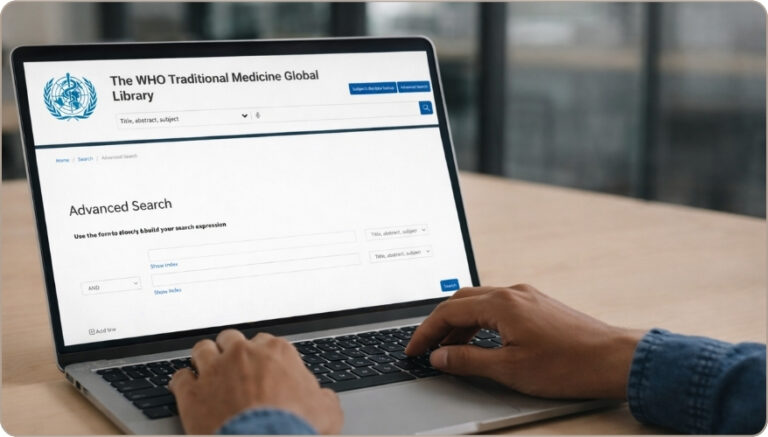
Between March 19 and 22, 2024, the World Health Organization (WHO) brought together experts, technicians, and institutional partners in India with the aim of translating the evidence-informed action agenda of the Gujarat Declaration into implementation and impact, establishing priorities for the first cycle of action of the Global Center and its structuring projects, including the WHO Global Library of Traditional Medicine (BIREME, 2024).
The establishment of a network of experts and supporters responds to a shared understanding within the WHO that the recognition, systematization, and integration of traditional medicines into health systems require collaborative arrangements that are sensitive to cultural contexts and different models of knowledge production. As discussed in technical meetings, Director João Paulo Souza explains that much of this challenge is related to the epistemic discussions that shape and sustain different models of knowledge production on health care, especially when seeking to engage in dialogue with practices developed outside the conventional biomedical paradigm (BIREME, 2024).
Since early 2024, the Library’s progressive growth has been supported by WHO Member States, academic institutions, and other supporters who contribute to the generation, organization, qualification, and dissemination of knowledge on Traditional, Complementary, and Integrative Medicines (TCIM).
These stakeholders form the operational and technical foundation of the Library and operate under a common framework, inspired by BIREME’s consolidated cooperative library models, such as the Virtual Health Library (VHL), and adapted to the specificities of traditional medicine systems in different countries and regions.
Particularly based on the idea of developing a VHL in this field, the VHL TCIM – Traditional, Complementary and Integrative Medicines of the Americas was established in 2015 through technical cooperation between BIREME, the Pan American Health Organization (PAHO) in Nicaragua, and the Institute of Natural Medicine and Complementary Therapies (IMNTC). In subsequent years, other countries joined through the TCIM Americas Network, which is responsible for the editorial coordination of the Regional VHL TCIM.
The Library operates through multi-level hierarchical architecture, in which regions, countries, scientific and academic institutions, and networks of TCM specialists can participate progressively, respecting:
- The health governance structures of Member States;
- The diversity of traditional medicine systems;
- Local ethical, cultural, and regulatory frameworks;
- The priorities defined by WHO Member States; and
- The WHO Global Strategy on Traditional Medicine (2025–2034).
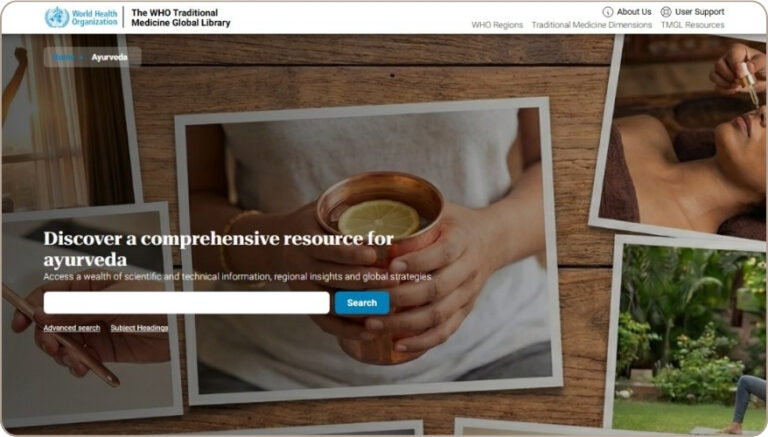
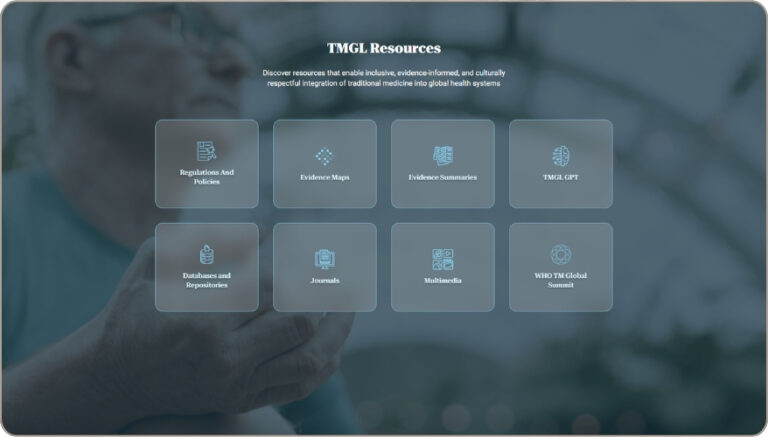
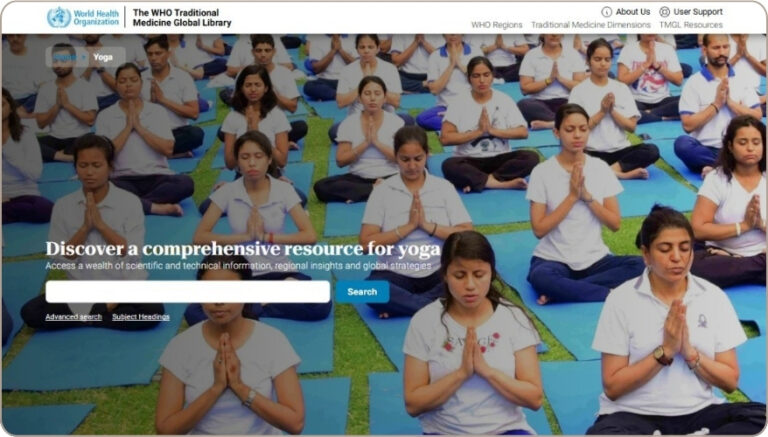
Adopted across the board by BIREME in its entire portfolio of information products, this model allows for the organization and updating of Library content at different interconnected levels, such as the MOSAICO database, which specializes in Traditional, Complementary, and Integrative Medicines and related health practices; regional portals; country pages, which serve as national entry points; and thematic instances, i.e., online portals dedicated to specific TCM systems, disciplines, or areas.
Governance and roles of contributors
In the WHO Global Library of Traditional Medicine, regional, country, and thematic instances are guided by a technical governance arrangement, which includes:
- An Editorial Advisory Group, responsible for guiding the scope, inclusion criteria, and strategic priorities;
- A technical-operational team, which contributes to the activities of identification, indexing, curation, and updating of content according to the methodology developed by BIREME;
- Institutional focal points that coordinate cooperation with BIREME, its regional offices, and technical partners.
The role of the WHO Global Center for Traditional Medicine in the development of the Library is inseparable from the expertise accumulated by BIREME as a specialized center of PAHO/WHO in health information management. In this context, BIREME provides methodological coordination, ongoing technical support, and assurance of alignment with WHO international standards, ensuring that the collections—general, regional, national, and thematic—are developed in a consistent, interoperable, and sustainable manner over time.
Nature of the Library and principles of integrity
The discussions that underpinned the development of the Library also emphasized the need for specific ethical safeguards for the treatment of traditional and indigenous knowledge. During the meetings of the GTMC and BIREME, concern was highlighted about avoiding extractivist or neocolonial approaches, including in the context of open science.
As published in BIREME Bulletin n° 86, an open and transparent approach “may not always be in the best interest of communities that hold traditional knowledge,” especially when this knowledge can be appropriated and patented without fair return to the communities of origin (BIREME, 2024).
The Library is a bibliographic and knowledge mapping platform, not an endorsement or recommendation mechanism. Its role is to ensure the transparent origin of sources, the quality of metadata, and a clear distinction between access to literature and normative guidance. The inclusion of documents does not imply validation, recommendation, or equivalence of evidence by WHO, whose guidelines and official positions are developed exclusively through formal normative processes, with rigorous evaluation of evidence and expert review.
The definition of clear rules of integrity and transparency was one of the central points in the technical discussions that led to the creation of the Library. All contributors are required to declare potential conflicts of interest, and any activity that could compromise the integrity, objectivity, or credibility of the Library must be avoided. The principles of transparency, accountability, and good ethical practices guide all partnerships and collaborations established within the scope of the project.
Capacity building
Capacity building is a key component of the WHO Global Traditional Medicine Library framework and is intrinsically linked to the strengthening of its national, regional, and thematic networks. This process supports the continuous learning of co-creation partners responsible for developing and maintaining the Library’s content and resources.
Through coordinated and cooperative action, the Library promotes:
- strengthening institutional capacities in scientific information management in Traditional, Complementary, and Integrative Medicine (TCIM);
- the progressive application of BIREME methodologies for the identification, description, indexing, validation, and curation of content (LILACS, DirEve, FI-Admin, Mosaico, and LILACS Multimedia);
- consistent use of controlled vocabularies, thematic structures, and common tools, such as DeCS/MeSH and the Library’s thematic clusters;
- harmonization of workflows and content validation among institutions, countries, and regions, according to the workflow defined for the Library’s thematic and country pages in partnership with the Global Center for Traditional Medicine.
According to BIREME’s technical team, these processes are designed and implemented collaboratively and with a focus on continuous learning. The goal is to enable WHO regional focal points to progressively support the integration of their information sources into the Library and develop autonomy in updating quality content in each instance. “Continuous technical validation, carried out in conjunction with subject matter experts and institutional focal points, ensures consistency, cultural relevance, and scientific rigor,” the team points out.
By articulating governance, technical cooperation, information management, and capacity development, the Library consolidates itself as a collaborative and strategic platform on a global scale. This approach strengthens the role of WHO Member States in promoting the safe, effective, and evidence-based use of traditional, complementary, and integrative medicines, while valuing the diversity of knowledge, cultural contexts, and local practices.