Searching with your own words: natural language on the VHL Regional Portal (part 1 of 2)
In last month’s article, this column discussed the foundations of AI: energy, water, hardware, and the accumulated human labor that no model can create out of thin air. This month, the series moves to the entry point—literally: the search box of the Virtual Health Library (VHL) Regional Portal.
There is a subtle cruelty inherent in every search box: to find something, it requires that we already know a little about how to search for it.
For a librarian or an experienced researcher, the search box can be a precise tool. Boolean operators, parentheses, quotation marks, fields, filters, DeCS subject headings: each element helps define what should be included and what should be excluded. For those who have mastered this “grammar,” a good search strategy is not only efficient—it is explicit, adjustable, and, above all, reproducible.
But many people — including me — land at the VHL website with something else in hand: a question. “What interventions help older adults adhere to hypertension treatment?” or “How do heat waves affect pregnant women’s health?” These people understand the problem, but they don’t always know the subject heading, the synonym used in the articles, the language in which the evidence was published, or the syntax needed to retrieve it.
This is the gap we’re working to bridge: the gap between knowing what you want to understand and knowing how the system expects it to be written. This is still a work in progress. And that’s precisely why now is a good time to show what lies behind that future search box, before everything seems too simple.
A new search, not a replacement
The VHL Regional Portal brings together approximately 60 databases and other types of health information sources. Its search interface is integrated with DeCS and offers filters, result export, and advanced search in Portuguese, Spanish, English, and French.[1] It is an infrastructure designed to enable control over large, heterogeneous, and multilingual collections.
Thus, the incorporation of this new search modality may raise important questions about the user experience. How can we offer natural-language search without obscuring or diminishing Boolean search? How can we make it clear that one is not the “smart” version of the other? How can we allow a librarian to retain control over a complex strategy while, at the same time, opening the door to those who can only articulate their needs as a question?
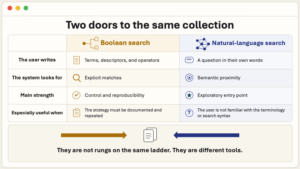
Boolean search and semantic search are not rungs on the same ladder. They are different tools. In Boolean search, the user specifies relationships between terms: this AND that; this OR its synonym; this, but NOT that. In natural language search, the system attempts to align the intent expressed in the query with the meaning represented in the documents.
For research that needs to be documented, replicated, and updated — such as systematic reviews, the control provided by an explicit strategy remains indispensable. For an exploratory query, where the user has not yet mastered the field’s terminology, semantic proximity can offer a more welcoming entry point. Intelligence, in this case, isn’t just a button. It lies in choosing the method best suited to the purpose.
Turning words into coordinates
To make this possible, we use embeddings. The word may sound more mysterious than the concept actually is.
An embedding model transforms text into a sequence of numbers, which we call a vector. This vector is not a summary, nor is it a list of keywords. We can imagine it as a set of coordinates on a map with thousands of dimensions. Texts considered semantically close tend to occupy regions close to one another in this space, even when they do not use exactly the same words.
Thus, a search for “high blood pressure during pregnancy” may yield results from documents that use “gestational hypertension.” In a multilingual model, a question in Portuguese may also yield results such as a title in Spanish, an abstract in English, or a record in French. This is especially relevant for the VHL: multilingualism, in this context, is not a secondary function. It directly contributes to BIREME’s mission of expanding access to and use of information, knowledge, and scientific evidence in support of health systems in Latin America and the Caribbean.
The process takes place in two stages. First, the documents in the collection are converted into vectors and organized into a dedicated index. This step can be performed before the search. Then, when the user enters a query, it must also be converted into a vector. This second transformation occurs in real time. Only then does the system search the numerical map for the documents closest to the query.
The vector space also has a “accent”
The Regional Portal’s collection is multilingual, and the Portal operates in four languages. We need a model that links “pressão alta na gravidez” to “hypertensive disorders of pregnancy,” “trastornos hipertensivos del embarazo,” and “troubles hypertensifs de la grossesse.” Note that none of these four forms is a literal translation of the others, and only the first (in Portuguese) is how someone would actually speak (in Brazil).
Embedding models are trained primarily in English. The practical consequence is that the quality of the semantic neighborhood varies by language and varies most precisely where our collection is most unique: Latin American and Caribbean public health literature, with local terminology, diseases with regional vernacular names, and works from both the French-speaking and English-speaking Caribbean. A model may not know that “quebra-ossos (bonebreaker)” and “classic dengue” refer to what DeCS records simply as “dengue”: a colloquial expression, a clinical term, and a descriptor.
In the prototype of the new search engine, we are experimenting with Qwen3-Embedding, which has 8 billion parameters. According to the technical documentation, the model supports more than 100 languages and can produce vectors with up to 4,096 dimensions.[2] These numbers are promising, but they do not constitute a definitive verdict. A model’s strong performance in international evaluations does not prove that it will work equally well with healthcare terminology, with scientific output from Latin America and the Caribbean, or with the way our users phrase their questions. The test that matters must take place within our own context.
It is also important to clarify what this technology is not capable of doing. The model does not converse with the user or write a clinical response. It calculates a numerical representation and helps organize documents. It is not an oracle. It is more like a compass, and as such, it also needs to be calibrated.
It is this calibration — technical, linguistic, and regional—that will allow us to assess whether natural language search can serve as a second gateway to the VHL. In the next part of this article, we’ll look at what still needs to be resolved to turn this possibility into a service: infrastructure, document representation, relevance criteria, and interface design.
See you next month.
By Francisco Barbosa Junior, Digital Solutions and Emerging Technologies at BIREME.
References
[1] VHL Regional Portal. About the VHL and the VHL Regional Portal.
[2] Zhang Y, Li M, Long D, et al. Qwen3 Embedding: Advancing Text Embedding and Reranking Through Foundation Models. 2025.