Paths to Agility: kaizen and the shokunins at BIREME (part 2 of 2)
By João Paulo Souza, Director of BIREME
In the first part of this article, we saw how Kaizen (改善) – the Japanese concept of “change for the better” – offers one of the deepest philosophical foundations of agility, by proposing that the most lasting improvement does not arise from one-off, grandiose reforms, but from the discipline of small, sustained adjustments over time, identified by those who actually perform the work. We also saw that this logic, although formalized as a management methodology in postwar Japan through the Toyota Production System, echoes much older philosophical traditions – the Wu Wei of Taoism and the shugyō of Zen Buddhism – and that, sustained over time, it produces a compound effect that no single transformation can replicate. In this second part, we move from this institutional principle to its most personal expression: the shokunin tradition, in which mastery of a craft becomes a lifelong commitment – and, from there, to the figure of the health information manager, whose daily practice at BIREME and in other public and international organizations can be a contemporary expression closely aligned with this same ethics.
Wabi-sabi: Making peace with imperfection
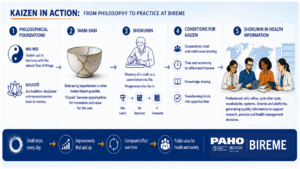
The process of continuous improvement of information products has no end. It is as if we were always in an operational beta version, and this can be a source of personal and institutional stress. Recognizing that the product is operational and being used, but still has areas for improvement and imperfections, can compromise the motivation and sustainability of this continuous improvement process. This is where the concept of wabi-sabi comes from – the perspective that finds beauty in imperfection, in the impermanent, and in the incomplete. A commonly cited example is kintsugi, the technique of repairing damaged porcelain by filling the cracks with gold: the repaired object does not hide the crack – it is more valuable because of it.
In this specific case, we might consider that we can add value to the product by identifying and prioritizing areas for improvement with the end user at the center, even generating innovation based on user needs. In other words, the cracks in the product can be filled with the gold of innovation arising from solving the user’s problems and addressing their needs.
Wabi-sabi is what makes Kaizen possible without being paralyzed by perfectionism. Importantly, if achieving perfection were a goal for the present, every current state – inevitably imperfect – would be a failure. Wabi-sabi reverses this logic: the imperfection of the present moment is not a flaw awaiting a definitive correction; it is the very material with which we work. Based on this acceptance, the continuous cycle of improvement opens the door to innovation and the development of the operation.
Shokunin: Mastery of a Craft as a Lifelong Commitment
While wabi-sabi helps to ease the tension that can arise from the process of continuous (and endless) improvement, the shokunin tradition (職人) reveals a more ambitious perspective. Shokunin is usually translated as “artisan,” but the term carries a dimension that this translation may not reflect. The artisan who devotes his or her life to mastering a craft understands that achieving mastery is an obligation to those who receive his or her work.
For the artisans in training themselves and for those who may play a role in training artisans, the training process follows the shu-ha-ri progression. First, shu, when a novice artisan seeks to master the original form, repeating it exactly as taught. Second, ha, when a fully-fledged artisan is able to introduce small, positive variations and improvements after having mastered the reproduction of the original form. Third, ri, when an experienced artisan manages to transcend the original form and create something truly original. In this sense, genuine creativity comes after – never before – the mastery of form. This is particularly relevant today, when there seems to be pressure to achieve quick results.
This tradition of artisan training predates any management theory by centuries yet bears a remarkable resemblance to Kaizen. The relationship between the two is not one of origin – Kaizen did not give rise to the shokunin, but rather systematized, in corporate language, a work ethic that the artisanal tradition had already been practicing for generations. Still, the shokunin is perhaps the purest expression of this ethic, embodied in a person and a craft: living proof that continuous improvement, sustained over many years and even decades, produces a level of mastery that no shortcut can replicate. Thus, achieving the capacity to innovate requires first mastering the current process, then introducing small improvements, and only later developing something entirely new to replace what we currently have.
BIREME’s Shokunins
This concept of shokunin resonates directly with BIREME’s day-to-day operations. In 2026, the Brazilian Ministry of Health regulated the practice of the public health profession in Brazil, which includes performing services related to the analysis, classification, research, interpretation, and production of scientific and technological information relevant to health, as well as contributing to the scientific and technological development of public health, while upholding a commitment to human dignity and the defense of the right to health. This regulation explicitly recognizes health information management as one of the areas of public health practice – a recognition that directly reflects what BIREME professionals have been doing for decades.
These professionals are not wood or metal artisans, but artisans of health information: specialists who devote a large part of their professional lives to the continuous refinement of vocabularies, information classification systems, libraries, and digital platforms – each version of a system building on the previous one, each revision incorporating what practice has helped to reveal. In this sense, they are health information shokunins – professionals whose mastery does not stem from a single project, but from sustained practice, refined cycle after cycle, in service to those who rely on information to make decisions regarding health research, practice, and management.
The Conditions for Kaizen
In institutional practice, the principles of Kaizen, wabi-sabi, and shokunin complement one another. Kaizen guides the continuous pursuit of small improvements; wabi-sabi helps us recognize imperfection and the incomplete nature of processes as a natural part of this journey; and shokunin embodies, on an individual level, the long-term commitment to mastery and refinement. In public and international organizations, this combination may encounter barriers such as fragmented processes, operational overload, resistance to change, and the difficulty of setting aside time and autonomy to reflect on work. On the other hand, a culture of cooperation, learning, trust, and knowledge sharing helps transform these limitations into opportunities for improvement. For BIREME, the challenge may not be merely to adopt Kaizen as a methodology, but to create the conditions that will allow its health information shokunins to practice it continuously, wisely acknowledging the imperfections of the present, learning through practice, and progressively improving processes, products, and services.
Conclusion
Kaizen reminds us that the agile frameworks we’ve discussed in this series of articles (for example, Scrum or Kanban) are frameworks that embody a much older and deeper principle: the conviction that the process of improvement has no end point and that value lies precisely in sustaining this process, increment by increment, with a calm acceptance of imperfection and a long-term commitment to one’s field of expertise. For organizations like BIREME, this discipline is not an add-on to the organization’s mission; it is the very means by which the mission is carried out, day after day, through those who practice it with great dedication.
Author’s note
Acknowledgments to Marcia Ymanaka Barretto for her contribution to the writing of the article, as well as for her careful review and approval of the final version.
References
Imai M. Kaizen: The Key to Japan’s Competitive Success. New York: McGraw-Hill; 1986.
Liker JK. The Toyota Way: 14 Management Principles from the World’s Greatest Manufacturer. New York: McGraw-Hill; 2004.
MORI, Takeshi. The Shokunin Mindset: Japanese Lessons for Work and Mastery. [S.l.]: Independently Published, 2025. 168 p. ISBN 979-8262337088.
Brazil. Law No. 14,725, of November 16, 2023. Regulates the sanitarian profession.
Brazil. Decree No. 12,921, of April 6, 2026. Regulates Law No. 14,725/2023.