Paths to Agility: Kaizen, the shokunins, and the Public Health Practitioners in BIREME
By João Paulo Souza, Director of BIREME.
This month, I would like to explore a topic that underpins many of the principles behind what we now refer to as the agile movement – a management approach that emphasizes collaboration, rapid adaptation to change, and the continuous delivery of value with a user-centered focus. These same principles can also be found in several agile implementation frameworks, including Scrum. That concept is Kaizen, which helps explain why some agile implementations succeed in certain contexts while others fail, especially when they are reduced to rituals devoid of meaning. This article is part of a special feature that will be published in two installments in the July and August editions of the BIREME Bulletin.
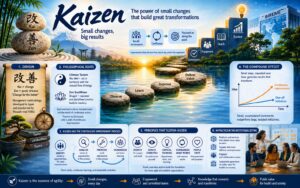
What Is Kaizen?
Kaizen (改善) is a Japanese term composed of two characters: kai, meaning change, and zen, meaning good or virtuous, and can be understood as “change for the better.” Its modern formulation as a management methodology emerged in post-World War II Japan through the Toyota Production System and was popularized by Masaaki Imai in Kaizen: The Key to Japan’s Competitive Success (1986).
In its industrial origins, Kaizen describes a well-defined discipline: small, frequent, and continuous improvements whose need is identified by the people who perform the work and who also play an active role in developing and implementing those improvements. Under this approach, innovation that improves a work process does not come from outside the operation or from senior management; rather, it emerges in response to a need or opportunity identified by those who are directly involved in the work itself.
Later, during the 2000s, the concept was reframed beyond the industrial context and became part of the fields of personal development and even self-help. In this context, publications such as One Small Step Can Change Your Life, by Robert Maurer’s, argue that small changes can foster long-term transformation without triggering the psychological resistance that major changes often provoke.
The Philosophical Roots of Kaizen
Although Kaizen evolved as a management approach, its roots lie in the ancient philosophical traditions of the East. Chinese Taoism, through its concept of Wu Wei – an action that gently follows the natural flow of things and may even take the form of non-action – suggests that the most profound transformations occur through subtle adjustments rather than abrupt interventions. Zen Buddhism contributes the concept of shugyō, a disciplined and repeated practice in which mastery is achieved not through the isolated execution of a single act, but through its conscious repetition until it becomes natural, performed with greater presence and confidence.
What these traditions share is the understanding that improvement is not an isolated event, but the result of sustained, continuous action. Importantly, there is no final point at which the process of improvement is considered “complete.” Instead, there is only the idea of continuous improvement, sustained through repeated, incremental practices rather than through large, one-time interventions imposed from outside the process.
Kaizen and the Process of Continuous Improvement
Applied to institutional work, Kaizen shifts the process of improvement away from one-time initiatives – those top-down transformation efforts that are disconnected from the day-to-day realities of operations and are often carried out as intensive, short-term efforts – and toward ongoing actions embedded in the daily work of organizations and supported by an organizational culture that embraces change. A project team that reviews and refines a product in every cycle, smoothing a point of friction in the user experience or simplifying a work process, achieves an improvement that, viewed in isolation, may seem modest. Yet this is precisely where the value of Kaizen lies: not in any single adjustment, but in the discipline of sustaining continuous improvement, one small increment after another.
The Compound Effect
When sustained over time, the process of continuous improvement produces something qualitatively different from any isolated intervention: the compound effect. Just as in finance, where small investments made consistently over time and combined with the reinvestment of returns generate growth trajectories that a single investment could rarely match, small increments of value accumulated in a product cycle after cycle produce a level of progress that even a major overhaul would struggle to replicate. This logic helps explain why organizations that practice continuous improvement tend to outperform, over the long term, those that rely on ambitious but sporadic initiatives.
Conclusion of Part 1
Kaizen, centered on small, continuous improvements identified by the people who perform the work, provides the foundation for agility by contrasting continuous improvement with one-time management initiatives. This approach generates a compound effect, surpassing large-scale and isolated transformations through subtle, repeated adjustments in the organization’s day-to-day activities – a logic that, as we have seen, echoes philosophical traditions far older than industrial management itself. In Part 2 of this article, we will explore how this same logic is embodied in the figure of the shokunin and how it can inspire the day-to-day practice of BIREME and other public and international organizations.
References – Part 1
Imai M. Kaizen: The Key to Japan’s Competitive Success. New York: McGraw-Hill; 1986.
Liker JK. The Toyota Way: 14 Management Principles from the World’s Greatest Manufacturer. New York: McGraw-Hill; 2004.
Takeuchi H, Nonaka I. The New New Product Development Game. Harvard Business Review. 1986;64(1):137-146.
Lao Tzu. Tao Te Ching. Translated by D.C. Lau. London: Penguin Classics; 1963.
Suzuki DT. Zen and Japanese Culture. Princeton: Princeton University Press; 1959.
Maurer R. One Small Step Can Change Your Life: The Kaizen Way. New York: Workman; 2004.