Collections reveal experiences and memories
From the indigenous lands of Oiapoque to the streets of Rio de Janeiro and homes transformed into classrooms, the collections of the COVID-19 Pandemic Digital Memorial bring together accounts, images, and records that document, from multiple perspectives, the experiences lived in Brazil during the health crisis. To gather and organize this diverse set of experiences, the Digital Memorial brings together materials of very different natures, from everyday records to official documentation, always guided by technical, legal, and ethical criteria that seek to ensure preservation, democratic access, and the protection of the people and communities involved.

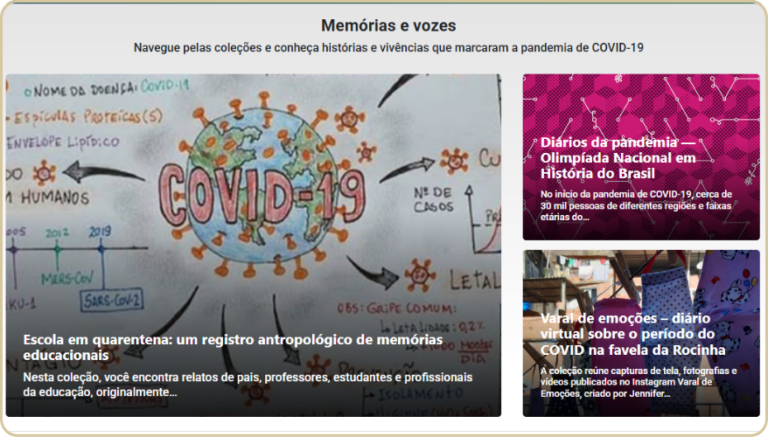
Among these, the memory projects created “in real time” by collectives, researchers, and social movements stand out; they have transformed social media, photographs, and diaries into intentional archives documenting what it means to live, fall ill, care for others, and fight during the pandemic. The first three collections available on the portal —“Speak Up, Relative! COVID-19 Has Arrived Among Us,” “Lives Matter,” and “School in Quarantine”— each exemplify, in their own way, this mission to document situated experiences while simultaneously revealing structural dimensions of the pandemic.

“Speak Up, Relative!” brings together one hundred textual accounts from leaders, nurses, students, teachers, elders, and young people of the Apalai, Galibi Kalin’a, Galibi-Marworno, Karipuna, Palikur-Arukwayene, Tiriyó, Kaxuyana, and Waiãpi peoples, narrating in the first person the arrival of COVID-19 in the indigenous lands of the Oiapoque region, in the far north of the country. The testimonies were collected by scholarship recipients from the Indigenous Tutorial Education Program (PET) of the Intercultural Indigenous Education Degree Program at the Universidade Federal do Amapá (UNIFAP), in formats such as texts, photographs, audio recordings, and videos. Published daily between May and August 2020 on the group’s Facebook page, these accounts were later compiled into the book “Speak Up, Relative! COVID-19 has arrived among us” (2021), in versions that include translations into English, French, and Spanish.
These accounts provide an almost real-time account of the spread of infections, mourning, and community responses, while also recalling memories of past epidemics, exposing the disconnect between urgent needs and government action, highlighting the use of social media as a platform for Indigenous voices, and documenting unique coping strategies—such as the revival and sharing of traditional medicines, the role of women and shamans, and the challenges of accessing the internet.
As Elissandra Barros, professor in the Intercultural Indigenous Education Program at UNIFAP and tutor for Indigenous PET, highlights in the book’s preface: “As COVID-19 spread, the accounts shifted in tone, becoming more dramatic and painful. Coronavirus infection was a reality, and the accounts began to describe the daily challenges and the struggle of individuals, families, and villages against COVID-19—some of which were lost. ‘COVID victims’ began to emerge among Indigenous communities, bringing with them a sense of helplessness and shared grief. The accounts of these deaths carry not only pain but also outrage, especially when the communities where they occurred were in a situation of little or no medical and/or government assistance, as is so often mentioned. One day, history will tell us how many of these lives could have been spared”.

The “Lives Matter” collection, meanwhile, turns its gaze to the city of Rio de Janeiro through an extensive black-and-white photo essay produced by photojournalist and historian Carlos Erbs Jr. Bringing together approximately 110 photographs, most of which were published in the book “Lives Matter – Visual Memory of the COVID-19 Pandemic in Rio de Janeiro” (2021), the project documents everything from the onset of social distancing measures to the phase of mass testing. The archives include acts of solidarity, vaccination campaigns, protests, scenes of mourning and denial, revealing, through images, the complex social, political, and human dynamics of the pandemic in the city.
The project follows public agencies, community movements, healthcare professionals, academic initiatives, and denialist groups, and combines rigorous journalistic documentation with historical awareness. As the author summarizes, it is “a political document of everything we have experienced,” created at personal risk and marked by the realization that we were living through an event comparable in impact to the Spanish flu a century earlier. As they explore the collection, visitors are invited to revisit empty and overcrowded urban spaces, gestures of protection and neglect, and to reflect on the need to remember “every victim, every instance of negligence” so that mistakes are not repeated in future health crises.

The “School in Quarantine” collection, in turn, shifts the focus to the educational sphere, addressing the impact of daily remote learning on the entire school community (parents, teachers, students, and support staff) through accounts posted in a closed Facebook group created in April 2020 by researchers Juliane Bazzo, Kelli Schmiguel, and Mana Lucena Suarez. The collection brings together texts, photographs, and some videos produced by over 500 participants, who transformed the social network into a space for sharing dilemmas, adaptations, and emotions related to remote learning, the reorganization of domestic and professional routines, the use of technology, and the maintenance of pedagogical and emotional bonds, during a time that “was completely out of the ordinary.”
Linked to the science outreach blog Primavera nos dentes, the project incorporated ethnographic tools, such as systematic observation, attentive listening, and thematic surveys, to organize the posts into original narratives, creating a collaborative archive that highlights both the overload faced by teachers and families and the creative attempts to navigate, on a daily basis, the challenges imposed by the pandemic. By preserving these records, the Memorial offers a window into school experiences lived “from the inside” of quarantine, showing how writing accounts of individual experiences in posts, comments, and photos also became a way to process uncertainties, anxieties, and hopes related to the future of education.
Taken together, these first three collections that make up the Digital Memorial of the COVID-19 Pandemic demonstrate the breadth and depth of the archive: from indigenous communities in the far north to the metropolises of the Southeast, from virtual classrooms to the streets, different voices speak out to transform pandemic experiences of vulnerability, resilience, and care into collective memory. They illustrate how projects produced during the pandemic—created by communities, researchers, and committed professionals—constitute fundamental documents for understanding not only what happened, but also how people sought to record and pass on this time to future generations.
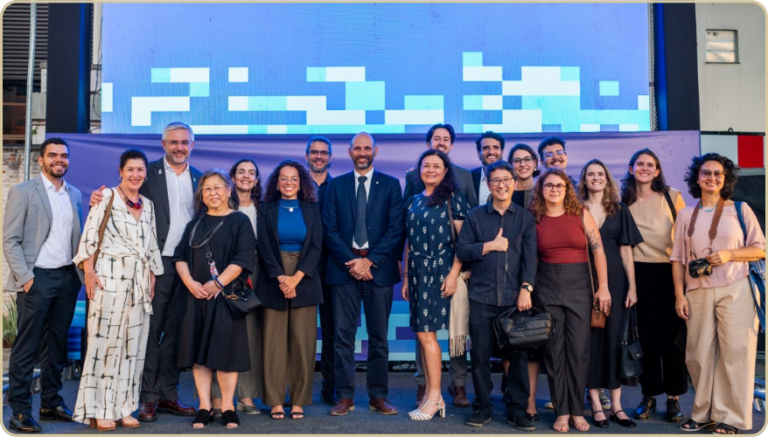
The COVID-19 Pandemic Digital Memorial is an initiative of the Ministry of Health, developed through the Ministry of Health’s Cultural Center (CCMS/CGDI/SAA/SE/MS), with technical implementation by the PAHO/WHO Latin American and Caribbean Center on Health Sciences Information (BIREME/PAHO/WHO) and the Center for Digital Humanities at the Universidade Estadual de Campinas (CHD/Unicamp). Learn more about inter-institutional cooperation in the article Records and memories safeguard experiences – BIREME/PAHO/WHO Bulletin.