Libraries and AI in the Face of Climate Change in the Anthropocene
In last month’s article, this column presented an overview of Artificial Intelligence as used at BIREME, highlighting its categories, strengths, and limitations. This month, the exploration of the topic continues. Having covered the basics, the series now delves deeper into the discussion to understand the infrastructure that supports these technologies, the resources they require, and the costs associated with their use.
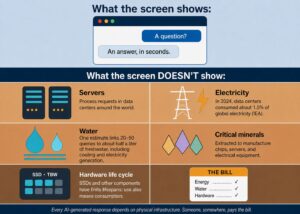
There’s an unspoken habit in the way we use generative AI today: everything seems ready-made, instant, and effortless. You type in a question, and the answer appears. The screen doesn’t show the rest. It doesn’t show the servers working somewhere on the planet, the electricity that powers them, the water used to cool them, the critical minerals mined to manufacture them, or the life cycle of the hardware that supports each operation. Computing seems abstract. “Cloud,” incidentally, is the word we’ve chosen for it, as if it had no grounding. But it does. It has grounding, consumption, and material consequences that help give meaning to the concept of the Anthropocene: a world in which human activity leaves its mark on planetary systems.[1] Every response generated by AI depends on a physical infrastructure, consumes resources, and generates costs that someone, somewhere, must bear.
I learned this lesson before I even knew it had a name. It was the first time I truly grasped, in a concrete way, the material costs of computing.
During my doctoral studies, I processed several terabytes of actigraphy data (body movement records) collected in a study of pregnant women. The analysis software performed intense read and write operations on a local SSD, nonstop, for several weeks. Until one morning, the drive simply stopped responding. Total failure. I later learned that SSDs have a finite endurance for writing. Manufacturers express this in a metric called TBW, or terabytes written: the cumulative volume of written data used as a benchmark for the drive’s durability and warranty.[2] I can’t say for certain that this limit caused that failure; SSDs can also fail due to problems with the controller, firmware, or other components. But the episode brought into sharp focus something that the user interface hides storage also has a life cycle. Those analyses were adding up writing cycles. I wasn’t just using the machine; I was, to some extent, wearing it out. What saved my thesis wasn’t luck: it was the backups I kept on other media—by design, not by chance.
I took two lessons from that day. First: Computing is not abstract. All processing requires physical infrastructure, energy, and equipment with a lifecycle. Second: when a machine fails—and they do fail—what protects you is not that machine. It’s the method: redundancy, backups, and the ability to recover.
Today, these costs are on a global scale. The International Energy Agency estimates that data centers consumed about 415 TWh of electricity in 2024, approximately 1.5% of the world’s total electricity. By 2030, this demand is projected to exceed 945 TWh, which is more than Japan’s current total consumption. In AI-optimized data centers, demand could more than quadruple during this period.[3] And the cost isn’t limited to electricity alone. A report published in June 2026 by the United Nations University estimates that, if the projected expansion of data centers continues, the water footprint associated with their electricity consumption could reach 9.3 trillion liters by 2030, while the land footprint could reach approximately 14,500 square kilometers. [4] The cost of a single user query to an artificial intelligence resource varies greatly depending on the model, the location and time of processing, the electricity mix, and the cooling system. According to an estimate published by researchers at the University of California, 20 to 50 queries to ChatGPT could correspond to the consumption of about half a liter of freshwater, considering both cooling and the water associated with electricity generation for data centers.[5] This is not a universal figure per conversation. However, when platforms process billions of commands daily, small footprints add up to significant infrastructure impacts. The cloud reveals its thirst.
Electricity and water are among the most visible costs. But there is another cost, one that is less quantifiable and perhaps even more valuable: decades of accumulated human labor. Catalogers, librarians, and specialists have enriched, record by record, the description of what each document was and where it should be retrieved. There’s no magic here; there are statistics behind this work. Cataloging has always been an act of trust: the promise that those who seek will find. When these records form a training corpus, that trust is transformed into data. AI doesn’t replace it, it inherits it. And a good inheritance is managed; it isn’t squandered. Managing this inheritance well includes choosing a technology commensurate with the problem. As this column showed in June: it is prudent and effective to use classical AI when it suffices; a small language model when it gets the job done; and a large model only when its generality is justified. Choosing the lightest tool capable of accomplishing the task is not merely an economic or technological decision. It is also an environmental decision—and one that can be understood as a method.
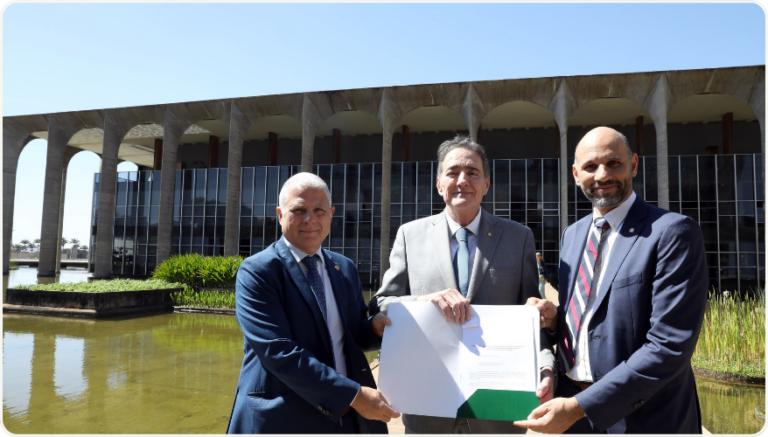
In July, these issues took on concrete form in Curitiba, the capital of the state of Paraná, Brazil. Luciana Piovezan Rio Branco, a librarian on the Digital Solutions and Emerging Technologies team, represented BIREME at the 31st Brazilian Congress on Library Science and Documentation, held in July 13–17. As part of the III Cataloging Forum, Luciana presented “BIREME’s Initiatives Using AI” at the roundtable discussion “Cataloging and Artificial Intelligence,” alongside representatives from Unicamp and IBICT/UFRJ.[6] The theme chosen by the congress spoke volumes: “Libraries on the Threshold of the Anthropocene.” A timely subject. To speak of AI infrastructure is also to speak of the Anthropocene: of energy, water, minerals, waste, and everything that the screen does not show. Libraries, the historical guardians of collections that must span centuries, may be among the best institutions to ask this question. They know that preservation is never instantaneous or immaterial. Books, images, metadata, memory: everything that needs to endure requires method, redundancy, criteria, and maintenance.
Luciana presented what BIREME has been developing in the areas of automatic indexing, metadata enrichment, and information retrieval. The most important point of her presentation, however, was not the demonstration of a tool. It was the criteria—human validation within the workflows. And transparency: all content produced with AI support in BIREME’s products is identified with the tag “Created by AI.” Incorrect health information is not just a harmless bug. It is a public health risk. Thus, when faced with each new possibility, the institutional question does not end with “can we build it?” It must go on to ask, “Who validates it, who is accountable, and under what criteria?”
This logic has also gained regional traction. In June 2026, PAHO, in partnership with the Inter-American Development Bank, published AI-GUARD (Artificial Intelligence Governance & Use Assessment for Responsible Deployment), a tool designed to guide the assessment of governance and use prior to the responsible deployment of AI systems in healthcare. [7] AI-GUARD embodies a simple principle: governance requirements must increase in proportion to the impact of the decision. Systems that influence diagnoses, eligibility, or resource allocation cannot be evaluated by the same standards as a low-impact administrative tool. There is a gap between what technology enables and what an institution commits to. It is within this gap that responsibility lies. AI-GUARD helps transform this gap into a process.
In June, I wrote: “Artificial Intelligence is accelerating. Human Intelligence is what makes the decisions.” What came out of Curitiba leads me to add: those who make the decisions also pay the price—in energy, in water, in hardware, in human labor, and in the trust inherited from those who cataloged before us. That SSD taught me early on that all computing comes at a cost and that no machine, on its own, constitutes a plan. The method must be part of the project. The question of our time is not just what AI can do. It is what use justifies its cost. And who signs the bill.
See you next month.
By Francisco Barbosa Junior, Digital Solutions and Emerging Technologies at BIREME.
References
[1] International Union of Geological Sciences. The Anthropocene: IUGS-ICS Statement. Março de 2024.
[2] Samsung Semiconductor. SSD Product Warranty — Limited Warranty Conditions and TBW.
[3] International Energy Agency. Energy and AI. 2025.
[4] Aczel, M. et al. Environmental Cost of AI’s Energy Use: Carbon, Water and Land Footprints. United Nations University Institute for Water, Environment and Health, 2026.
[5] Li, P.; Yang, J.; Islam, M. A.; Ren, S. Making AI Less “Thirsty”: Uncovering and Addressing the Secret Water Footprint of AI Models.
[6] XXXI Congresso Brasileiro de Biblioteconomia e Documentação. Programação oficial do III Fórum de Catalogação.
[7] Organização Pan-Americana da Saúde. AI-GUARD Tool: Governance & Use Assessment for Responsible Deployment. Junho de 2026.