Pathways to Agility: innovation pillars converge in health knowledge management
The Paths to Agility series was created as a space for reflection on the organizational transformation processes necessary for institutions dedicated to knowledge management to remain relevant in a landscape marked by complexity, technological acceleration, and the emergence of new scientific, social, and cultural paradigms. More than just the adoption of agile methods, this journey involves strengthening the institutional capacity to learn continuously, reorganize processes, incorporate emerging technologies, and expanding the dialogue between different ways of producing knowledge.
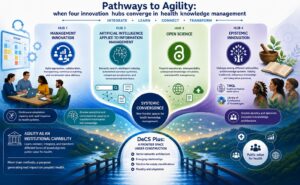
In this context, BIREME has been consolidating four strategic innovation hubs that, in an integrated manner, expand its role as a leading organization in health knowledge management.
By João Paulo Souza, Director of BIREME.
Nucleus 1: Innovation in management
The first nucleus focuses on innovation in management, particularly through the gradual implementation of agile approaches and the Scrum framework. Agility represents a cultural shift toward collaboration, transparency, continuous learning, and incremental delivery of value. In an organization historically structured around classical management models, the transition to a product-based approach, multidisciplinary teams, and short adaptation cycles require new institutional competencies and new leadership models.
Nucleus 2: Artificial Intelligence applied to information management
The second nucleus involves artificial intelligence-based solutions applied to health information and knowledge management. The expansion of large language models and generative artificial intelligence (AI) technologies creates unprecedented opportunities to transform how scientific knowledge is organized, retrieved, synthesized, and used to support decision-making. BIREME has been exploring applications of semantic search, intelligent indexing, automated narrative synthesis, and conversational interfaces for accessing scientific and technical information.
Nucleus 3: Open science
The third nucleus relates to the evolving role of libraries and information centers in the context of the global open science movement. BIREME has been expanding its activities in initiatives related to open science, including preprint repositories, strengthening interoperability, and broadening the circulation of scientific knowledge through emerging technologies —responding to the need to accelerate the sharing of evidence and democratize access to health knowledge.
Nucleus 4: Epistemic innovation
The fourth nucleus represents the broadest dimension of innovation: epistemic innovation. Health information management now also requires the ability to foster dialogue among different rationalities and knowledge systems. The World Health Organization (WHO) Traditional Medicine Global Library, for example, developed by BIREME in cooperation with the WHO Global Traditional Medicine Centre, embodies this approach by bringing together more than 1.8 million publications on traditional, complementary, and integrative medicines. In the same vein, the proposal for a Traditional Medicine Confluence Library in coordination with the Brazilian Ministry of Education reflects the search for more inclusive and pluralistic models, valuing dialogue between contemporary science, traditional knowledge, ancestral Quilombola knowledge, and integrative practices.
The human element: team, capabilities, and values
None of these transformations can happen without people, human capital in organizations. Agility, artificial intelligence, open science, and epistemic innovation are built day by day by teams that choose to act in a certain way.
Scrum organizes this approach around five values: commitment, focus, openness, respect, and courage. These are not merely decorative values; they describe the collective mindset needed to operate in uncharted territory, take responsibility for results, acknowledge what isn’t working, and sustain transformation even when it causes discomfort.
Alongside these values, the continuous strengthening of capabilities is a structural condition for innovation to cease being episodic and become an integral part of the organization’s daily operations. Without this human element, the four core elements described in this article remain mere intentions. With it, they become a movement and result.
Confluence as a transformative force
The transformative potential of these movements lies not only in each individual component, but in the dynamic interaction among them. Organizational agility enhances the capacity for continuous adaptation; artificial intelligence expands analytical possibilities and value delivery; open science strengthens the circulation of knowledge; and epistemic innovation broadens the cultural and cognitive horizons of the very architecture of knowledge. It is at the confluence of these four dimensions that new frontier spaces emerge for health knowledge management, making possible the development of innovative solutions and the conceptualization of digital products operating at the frontiers of health information science. Table 1 presents a conceptual product resulting from this convergence.
Agility as an institutional capacity
This transformation reflects BIREME’s own evolution: from an organization dedicated to biomedical information management to an institution capable of operating at the intersections of artificial intelligence, open science, complex systems, and intercultural dialogue of knowledge. It is in this deeper sense that agility reveals its true scope: not as an operational methodology, but as an institutional capacity to continuously learn, connect, integrate, and transform different forms of knowledge into public value for health.
| Quadro 1 – DeCS Plus: a frontier space under construction |
| A concrete example of this movement is the conceptualization of DeCS Plus. Traditionally, biomedical classification systems have been structured around relatively rigid hierarchical taxonomies—fundamental for organizing scientific literature but limited when applied to knowledge that operates based on other rationalities.
The future DeCS Plus proposes a new generation of semantic architecture, based on vector representations and semantic relationships derived from the documentary content itself, rather than the prior application of fixed categories. This approach opens up relevant possibilities for collections related to traditional medicines, indigenous knowledge, and integrative practices—domains historically underrepresented in classical biomedical classification systems. Vector classification enabled by artificial intelligence allows us to identify emerging semantic patterns, latent relationships, and conceptual clusters derived from the document corpus itself, while also revealing gaps in classification where certain concepts or epistemologies remain underrepresented. DeCS Plus thus embodies a broader transformation: the transition from predominantly prescriptive classification models to more adaptive, relational, and pluralistic semantic architectures. |
Author’s notes
This article was supported by generative artificial intelligence tools to assist in the drafting of texts, translations, and images. The conception, curation, critical review, and final approval of the content were carried out by João Paulo Souza, who assumes full responsibility for the published text.
Acknowledgments to Ana Carolina Franzon and Silvia de Valentin for their contributions and suggestions on the preliminary versions of the manuscript.