Guatemala VHL relaunch with the PHC and Nutrition Project Window of Knowledge
Guatemala celebrated a strategic milestone for strengthening information management with the official relaunch of its Virtual Health Library – Guatemala VHL. The ceremony brought together representatives from PAHO/WHO, the University of San Carlos of Guatemala (USAC), BIREME/PAHO/WHO, and national institutions that are part of the VHL Network, consolidating a collective effort that spans more than two decades.
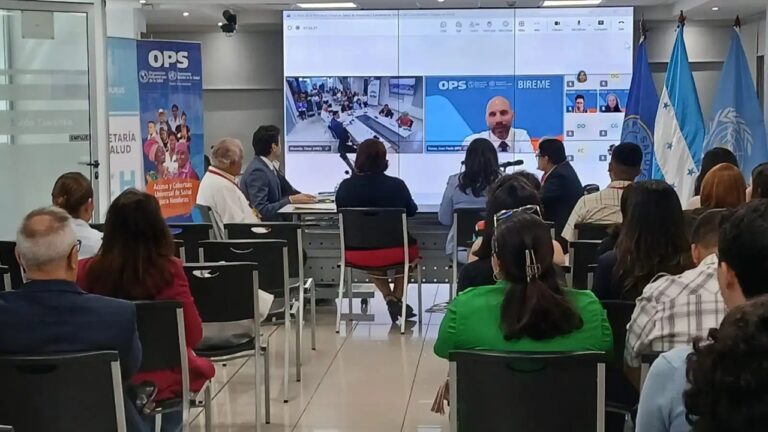
The event was held on November 26, 2025, in person at the Central Campus of USAC, with remote participation by BIREME and live broadcast on Facebook (LINK). The ceremony featured a welcome by Alba Dely Ramos, coordinator of the Guatemala VHL Advisory Committee, opening remarks by Alfredo Moreno, coordinator of the Graduate School of the USAC Faculty of Medical Sciences, and speeches by Alma Morales, PAHO/WHO Representative in Guatemala and João Paulo de Souza, director of BIREME/PAHO/WHO.
The new interface of the Guatemala VHL, highlighting its objectives, features, and benefits, was presented by Valentina Santacruz,  a documentalist at the Library of the Institute of Nutrition of Central America and Panama (INCAP). The event also featured a presentation of the Primary Health Care (PHC) and Nutrition Project Window of Knowledge, part of the “K’at: Living Memory Network” initiative, developed under the coordination of Alexandre Florencio, advisor on Health Systems and Services, and presented by Karen Cardona, consultant on Communication, Visibility, and Knowledge Management at PAHO/WHO Guatemala.
Guatemala VHL: a living organism that renews and evolves
In his speech, the director of BIREME/PAHO/WHO, João Paulo de Souza, emphasized that the relaunch of Guatemala VHL represents much more than a technological update: it is the reaffirmation of a historic commitment that began in the late 1990s, when the country decided to build its own national Virtual Health Library. “The VHL goes through continuous cycles; it is born, matures, evolves, and is reborn,” he said, emphasizing that Guatemala VHL is now experiencing a new moment, marked by expanded capabilities, new partnerships, and renewed energy.
The director emphasized that Virtual Health Library fulfils a role that goes beyond that of a repository. “The VHL instances are platforms for cooperation, bringing together institutions, research traditions, universities, ministries, and communities, functioning as meeting spaces for those who produce, organize, and use information to save lives, support public policies, teach, innovate, and transform realities.”
João Paulo also highlighted Guatemala’s growing role in the VHL Network. He noted that the coordination of institutions and the country’s ongoing contributions to the regional LILACS database demonstrate its active integration into an international knowledge-sharing system, representing progress sustained by genuine cooperation, institutional trust, and a shared vision.
New interface: modern, accessible, and aligned with VHL Network standards
During the ceremony, PAHO/WHO representative in Guatemala Alma Morales emphasized that the relaunch of Guatemala VHL “is not just a technological update, but a commitment to quality, transparency, and equity in access to health information.” She highlighted that the VHL has established itself as a key space for organizing and preserving national scientific output in open access and supporting research, training, and public policy making.
Alma Morales also noted that Guatemala currently has 1,190 scientific journal records indexed in LILACS, strengthening the visibility of science produced in the country. She reiterated the importance of evidence, community participation, and PHC for strengthening the health system and thanked the teams and institutions that support the platform.
With technical support from BIREME, the new Guatemala VHL interface presented during the event includes technical details such as updated design and accessibility; WordPress hosting; reorganization of information types and sources; more user-friendly and responsive navigation; and full integration with VHL Model methodologies, including improved search mechanisms.
At the end of the ceremony, it was clear that Guatemala VHL is beginning a new cycle sustained by a legacy of cooperation, installed technical capacity, and a national network committed to keeping alive a platform that is essential for science and public health in the country.
Access the Guatemala VHL and learn about the Window of Knowledge PHC and Nutrition Project.
See also the news item published by PAHO Guatemala (in Spanish) Guatemala presenta la Vitrina del Conocimiento del Proyecto de Atención Primaria en Salud y Nutrición integrada a la BVS Guatemala.