Organizing continuous improvement: Kanban and Scrum for more agile management
By João Paulo Souza, Director of BIREME
In the previous articles in this series, we explored Kaizen as a philosophy of continuous improvement grounded in the idea that meaningful development is built over time and emerges from small improvements incorporated into everyday work. Major breakthroughs are not the only pathway to sustainable transformation.
This raises a practical question: how can we organize work so that improvement becomes part of the way an organization operates?
Lean thinking, Kanban and Scrum offer useful approaches. Although they have different origins, they share important principles: creating value, making work visible, reducing unnecessary effort and delays, shortening feedback loops, and learning through practice.
Lean contributes a systemic perspective. Rather than asking only whether individuals or activities are efficient, it considers the entire flow through which value is created. An organization may have highly productive professionals and still deliver slowly because work accumulates between stages, priorities compete, responsibilities are repeatedly transferred, or too many activities are undertaken simultaneously.
The question therefore shifts from “How can we do more?” to “How can we make work flow better and generate more value?”. Kanban and Scrum provide different, and potentially complementary, responses.
Kanban: making work and its flow visible
Kanban offers an intuitive way to introduce continuous improvement into everyday management. Its most recognizable principle is also one of its most useful: make work visible.
In knowledge-intensive organizations, much of the work remains invisible. Requests arrive through different channels, priorities compete, and new activities begin before previous ones are completed. Everyone may be busy while the system as a whole delivers slowly.
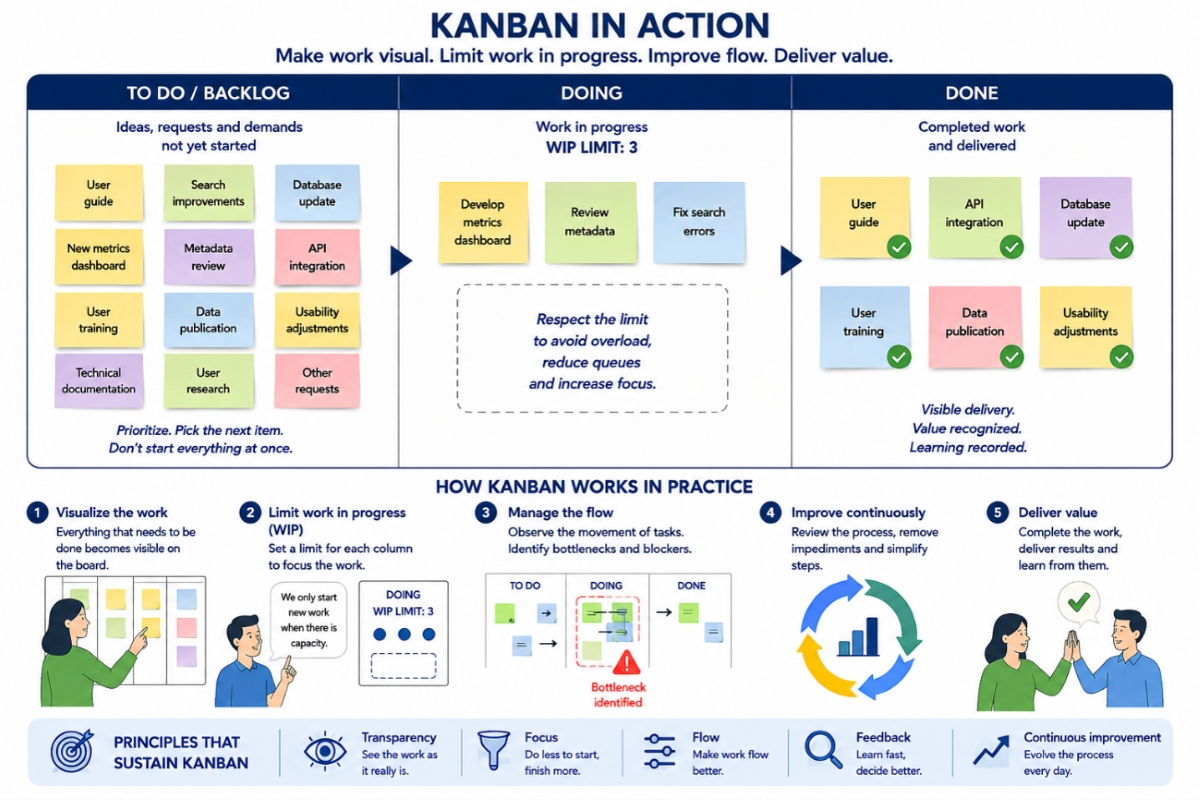
A Kanban board makes this work observable. In its simplest form, as illustrated in Figure 1, activities can be represented in three broad stages: what needs to be done (To Do/Backlog), what is currently being worked on (Doing), and what has been completed (Done).
The value of Kanban, however, does not come from moving cards across a board. The board reveals the flow of work. Where does work accumulate? Where are the bottlenecks? What prevents an activity from moving forward? How long does a request take to move through the system? Are we starting more work than we can finish?
This leads to another important practice: limiting work in progress (WIP). Teams establish a maximum number of activities that can be undertaken simultaneously — three, for example — and are encouraged to finish or unblock existing work before starting something new.
This may seem counterintuitive where productivity is associated with constant activity. Yet starting less can help us finish more. Reducing simultaneous work improves focus, exposes bottlenecks and can make delivery more predictable.
Kanban is particularly useful where work is continuous: managing services, responding to demands, maintaining digital products, resolving issues and implementing successive improvements. Here, improvement becomes part of operations rather than a separate initiative.
This also makes Kanban an accessible entry point for agile transformation. Organizations can start by making existing work visible, establishing priorities, limiting WIP and managing flow, without immediately redesigning teams or introducing an entirely new management framework.
Figure 1 summarizes this logic: visualize work, limit WIP, manage flow, identify impediments and improve. The work process itself becomes an object of observation and learning.
Scrum: organizing complex work through cycles of learning
Scrum approaches work differently. Rather than primarily managing continuous flow, it provides a structured framework for addressing complex problems through short cycles of delivery, inspection and adaptation. Its main components are summarized in Figure 2.
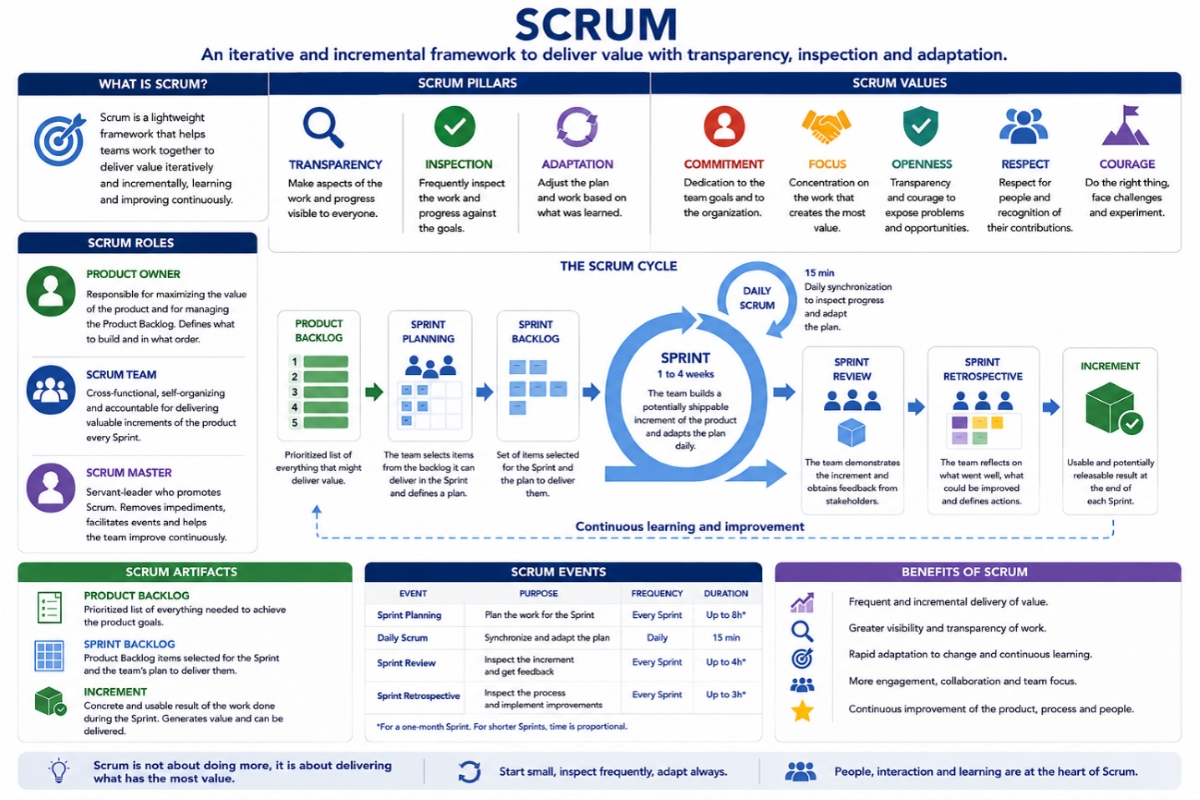
Work is organized around a Product Backlog, an ordered view of what may be needed to improve a product. During Sprint Planning, the team establishes a goal and identifies the work required to pursue it. The Sprint provides a fixed period, no longer than one month, during which the team works toward that goal and creates a usable increment.
Scrum builds opportunities for learning into this cycle. The Daily Scrum allows developers to inspect progress and adapt their plan. The Sprint Review examines results with stakeholders and considers changes in needs, priorities and context. The Sprint Retrospective focuses on how the team works and what should change in the next cycle.
The strength of Scrum lies less in its meetings than in the cadence of transparency, inspection and adaptation they establish. It shortens the distance between doing, observing, learning and adapting.
This can be particularly valuable for selected initiatives involving complexity and uncertainty, especially during intensive phases of product or service development. When needs evolve, solutions cannot be fully specified in advance, and interaction with users and stakeholders matters, short development and feedback cycles reduce the risks of prolonged implementation based on untested assumptions.
The connection with Kaizen is clear: improvement becomes embedded in the rhythm of work.
Kanban or Scrum? The nature of the work matters
Kanban and Scrum should not be treated as competing approaches, nor should Scrum be regarded as a more advanced stage that every team must eventually reach. Their usefulness depends on the nature of the work.
Kanban is well suited to continuous flows of demand and to the ongoing operation and improvement of products and services. Scrum can be valuable for complex development work that benefits from greater focus, relatively stable teams, short learning cycles and frequent feedback.
They can also coexist. A digital product, for example, may use Scrum during an intensive development phase and rely predominantly on Kanban as it moves into continuous operation, maintenance and incremental improvement.
There may also be practical advantages to introducing Kanban first in an organizational transformation. Making work visible, establishing priorities, limiting WIP and managing flow can generate useful insights without requiring a major redesign of how teams operate.
Scrum can then be introduced selectively where its structured iterative approach offers a clear advantage. This is not a progression from a simpler to a more advanced framework. For many types of work, Kanban may remain the better fit.
The principle is straightforward: choose the framework according to the work rather than forcing the work to conform to a preferred framework.
The relevant question is therefore not “Which framework is more agile?” but “How should we organize our work so that we can learn while delivering value?”
When that question guides the choice and adaptation of methods, agility moves beyond a collection of practices and becomes an organizational capability.