Pathways to Agility: organizational capabilities as the foundation of transformation
The three previous articles in this series explored complementary dimensions of agile transformation: agility as an organizational mindset, institutional culture as its foundation, and the innovation hubs converging in health knowledge management. This fourth article deepens a question that runs through all these movements: how do organizations actually develop the capacity to be agile?
By João Paulo Souza, Director of BIREME.
Beyond frameworks
As agile approaches become more widely adopted across the public sector and international organizations, considerable attention has been given to frameworks such as Scrum and Kanban. These models offer practical ways of organizing work, improving collaboration, and delivering value incrementally. Yet organizations adopting the same frameworks often achieve very different results.
The explanation rarely lies in the framework itself. Frameworks describe how work can be organized, but they do not explain how institutions build the genuine ability to shift the focus from bureaucratic deliverables to deliverables that generate real value for users. This requires product teams to develop deep knowledge of the business, the target audience, and the flexibility to adapt to change and learn continuously.
Competencies and capabilities: an essential distinction
Developing agility requires attention to two complementary dimensions that are frequently conflated.
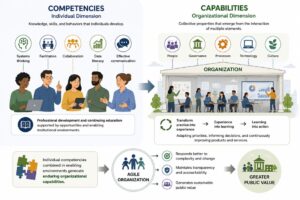
Competencies refer to the knowledge, skills, and behaviors of individuals. Systems thinking, facilitation, collaboration, data literacy, and effective communication all contribute to agile work. Investing in professional development and continuing education is therefore an essential component of organizational transformation. While this depends partly on individual motivation and personal investment in one’s own growth, it also requires institutions to create opportunities and environments conducive to that development.
Capabilities, however, exist at the organizational level. They emerge from the interaction of people, governance, processes, technology, and culture. An organization demonstrates capability when it can transform practice into experience and experience into learning. But learning, to be effective, must be put into action — adapting priorities, informing decisions, and resulting in the continuous improvement of products and services. These are collective properties that cannot be reduced to the individual expertise of each professional. In other words, organizational capability can be greater than the sum of its parts.
Organizations do not become agile simply by employing highly competent people. They become agile by creating environments in which individual competencies combine to produce enduring organizational capabilities.
Capabilities are built through practice
Organizational capabilities cannot be acquired through training alone. While education strengthens individual competencies, capabilities develop through repeated cycles of practice, reflection, feedback, and adaptation. They are built by doing.
This perspective helps explain why agile transformations take time. Organizations committed to agile transformation are not merely adopting a new management framework — they are gradually changing how decisions are made, seeking to collaborate across functions, and responding to information that emerges in the process. Over time, these repeated learning cycles become embedded in everyday work and gradually reshape organizational culture.
Among the capabilities that most consistently support agility are continuous learning, adaptive decision-making, cross-functional collaboration, evidence-informed management, and the sustained stewardship of products and services.
Together, these capabilities enable organizations to respond more effectively to complexity while maintaining transparency and accountability.
Agility as institutional capability
Viewing agility through the lens of organizational capabilities offers a broader understanding of transformation in public institutions. Agile frameworks remain valuable operating models, but they should be understood as enablers of transformation — not as the transformation itself. Their greatest contribution lies in creating conditions for teams and the organization to learn, adapt, and continuously improve.
Ultimately, agile transformation is less about implementing a framework than about strengthening the organizational capacity to generate public value under conditions of continuous change. For knowledge-intensive institutions such as BIREME, developing these capabilities is not simply an operational objective — it is a strategic investment in the organization’s ability to fulfill its mission in an increasingly complex world.
This series will continue exploring how these foundations translate into concrete practices of governance, leadership, and institutional work organization.
References
- Argyris C, Schön DA. Organizational Learning II: Theory, Method, and Practice. Reading, MA: Addison-Wesley; 1996.
- Bryson JM, Crosby BC, Bloomberg L. Public Value and Public Administration. Washington: Georgetown University Press; 2015.
- Edmondson AC. The Fearless Organization: Creating Psychological Safety in the Workplace for Learning, Innovation, and Growth. Hoboken: Wiley; 2018.
- Hynes W, Lees M, Müller J (eds.). Systemic Thinking for Policy Making: The Potential of Systems Analysis for Addressing Global Policy Challenges in the 21st Century. Paris: OECD Publishing; 2020. https://doi.org/10.1787/879c4f7a-en
- Lapuente V, Van de Walle S. The Effects of New Public Management on the Quality of Public Services. Governance. 2020;33(3):461–475.
- Schein EH, Schein PA. Organizational Culture and Leadership. 5th ed. Hoboken: Wiley; 2017.
- Senge PM. The Fifth Discipline: The Art and Practice of the Learning Organization. New York: Doubleday; 1990.
- Teece DJ. Explicating Dynamic Capabilities: The Nature and Microfoundations of (Sustainable) Enterprise Performance. Strategic Management Journal. 2007;28(13):1319–1350.
- World Health Organization. Everybody’s Business: Strengthening Health Systems to Improve Health Outcomes. Geneva: WHO; 2007.
- World Health Organization. Global Strategy on Digital Health 2020–2025. Geneva: WHO; 2021.