Recognition for the WHO Global Traditional Medicine Library
The 79th World Health Assembly (WHA79), held in Geneva on May 18-23, 2026, brought together delegations from more than 190 countries to set global health priorities and advance discussions on some of the most pressing health challenges on a global scale.
This year’s session took place at a time of intensifying pressures on health systems: persistent inequities, growing demand for care, and strained resources call for new and complementary approaches that strengthen primary care and advance universal health coverage. In this context, Traditional Medicine was established as an emerging strategic priority—and the World Health Organization’s Traditional Medicine Global Library (WHO TMGL) played a central coordinating role in this agenda at various levels.
The Director-General’s Address: The TMGL at the Highest Level of the WHO
In his address to Member States, WHO Director-General Dr. Tedros Adhanom Ghebreyesus highlighted the launch of the TMGL as part of initiatives aimed at strengthening health systems and advancing universal health coverage. The mention of the platform came alongside other strategic initiatives by the WHO—such as the update to the List of Essential Medicines and the expansion of national regulatory authorities recognized by the Organization—an unequivocal sign that the TMGL is viewed, at the highest level of the institution, as strategic infrastructure. This recognition is the result of a consistent trajectory: the adoption of the WHO Global Strategy on Traditional Medicine 2025–2034 at WHA78, described as a historic milestone; the public launch of the TMGL in December 2025; its incorporation into the Delhi Declaration; and now, its cross-cutting presence in the most important forums of the global health agenda.
The presence of the Director of the Pan American Health Organization (PAHO), Dr. Jarbas Barbosa, gave the occasion an explicit hemispheric dimension. On the sidelines of the Assembly, Dr. Jarbas held a series of high-level bilateral meetings with health ministers from the Americas and with leaders of global institutions and partners, ensuring—as he emphasized—that “the realities and priorities of our region are reflected in global decisions.” (PAHO, 2026).
This active engagement by the Americas was reflected in the composition of the Brazilian delegation—one of the largest in the region—led by Health Minister Alexandre Padilha and Ambassador Tovar da Silva Nunes, and including the President of Fiocruz, Mario Moreira, as well as representatives from the National Health Council (CNS), the National Health Surveillance Agency (Anvisa), the Butantan Institute, the National Council of Municipal Health Secretariats (Conasems), and Brazil’s Permanent Mission to the UN in Geneva (Fiocruz, 2026). This coordination between PAHO’s regional leadership and the diverse representation of the Brazilian health system signals Brazil’s growing interest in taking an active role in global health governance—and, by extension, in the agenda embodied by TMGL.
TMGL in the Institutional Narratives of Side Events on Traditional Medicine
One year after the adoption of the Global Strategy on Traditional Medicine at WHA78, this edition delved deeper into the discussion on how to accelerate its implementation through safe, effective, evidence-based, and people-centered solutions. Beyond the plenary session, it was during the side events organized by the GTMC that institutional narratives on TMGL gained greater analytical depth. The discussions focused on youth engagement, strengthening research and regulation, and integrating traditional medicine into health systems—particularly through primary care—and highlighted its cross-sectoral impact.
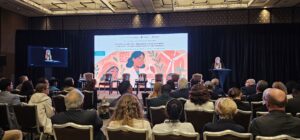
At the side event “Traditional Medicine Innovation for Health Impact: Financing, Collaboration, and Future Pathways,” held on May 19, Dr. Sylvie Briand, Chief Scientist at the WHO, framed the integration of traditional medicine within a broader strategic context: health systems are facing increasing pressures, and there is a global demand for preventive and person-centered approaches.
“The future of health care systems should focus on how evidence-based traditional medicine can complement biomedical practices. Evidence and ethics must advance hand in hand.” Dr. Sylvie Briand, Chief Scientist at the WHO —WHA79
At the same event, Shyama Kuruvilla of the GTMC put the scale and urgency of the agenda into context. In presenting data from the TMGL—approximately two million scientific records on a platform built in collaboration with regional partners such as BIREME/PAHO—the director highlighted the contradiction between the global relevance of traditional medicine and the underinvestment that still characterizes it: less than 1% of global health research funding is allocated to this field.
“That’s not a niche. You could say it’s the world’s predominant healthcare system.” Shyama Kuruvilla, WHO Global Traditional Medicine Centre — GTMC Side event, WHA79
The other GTMC side events explored equally relevant aspects of the agenda. “Traditional Medicine at the Nexus of Climate, Biodiversity, and Land Restoration” positioned traditional medicine as a link between health, ecosystem resilience, and sustainable development, highlighting the threats that climate change and biodiversity loss pose to medicinal species and traditional knowledge systems. Meanwhile, “Youth Leadership to Advance Traditional Medicine for Equity and Access” reinforced the intergenerational dimension of the agenda, positioning youth as strategic agents in integrating traditional medicine into global health systems. Together, the three events explored how to accelerate progress on this agenda, in which Traditional Medicine (TM) and TMGL, as a governance platform for this knowledge, play a fundamental role.
TMGL in the GTMC’s 2025 Annual Report: Collaborative Delivery and Strategic Priority
The WHO Global Traditional Medicine Center’s 2025 Annual Report ranks the TMGL among the WHO’s key strategic achievements in traditional medicine. Presented as the most comprehensive digital library ever developed by the Organization in this field, the platform features prominently throughout the document and, for the first time, receives systematic institutional recognition as a central component of the global agenda for implementing the Global Strategy on Traditional Medicine 2025–2034. More than just a tool for accessing information, the TMGL is described as a global knowledge infrastructure, designed to address the historical fragmentation of scientific literature on traditional medicine and promote equitable access to evidence across all WHO Member States.
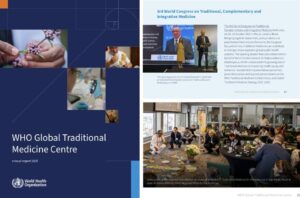
The document describes the TMGL as a global knowledge infrastructure designed to address the historical fragmentation of the scientific literature on traditional medicine and promote equitable access to evidence across all WHO Member States. With over 1.6 million records and global coverage, the Library is presented as one of the main tools for strengthening the production, circulation, and use of scientific knowledge in this field, in addition to serving as a portal for direct access to information.
The report explicitly recognizes BIREME/PAHO as a strategic partner in the development of TMGL. In collaboration with the GTMC and WHO regional offices, the Center led key stages in the design and implementation of the platform, drawing on nearly six decades of experience in scientific information management, technical cooperation, and the development of health knowledge networks. This recognition formalizes the BIREME–GTMC partnership as one of the pillars of the Library’s construction and continuous improvement—rooted in the methodological legacy of the Virtual Health Library (VHL) and the MTCI Americas VHL initiative, one of the key conceptual references that inspired the creation of the TMGL.
This trajectory has enabled BIREME to play a technical leadership role in defining the platform’s information architecture, including metadata models, interoperability standards, technological development, and integration with regional and international content sources and networks. In the section dedicated to the achievements of the Region of the Americas, the report also highlights BIREME’s coordination of the collaborative TMGL development process: the conduct of regional consultations, the systematization of expert contributions, the participatory implementation of the platform, and the coordination of collaborative networks to broaden the representativeness of the content. Among the contributions mentioned, the creation of the Library’s first thematic page—dedicated to traditional birth assistance (TBA) in the Americas—stands out; this initiative underscores the platform’s commitment to valuing traditional knowledge and its relevance to contemporary public health.
The report sets out concrete impact indicators for the coming years: incorporation of the platform into national policies, strengthening of health literacy, consolidation of safety and efficacy standards, and integration of evidence on implementation and health economics into decision-making processes. By featuring simultaneously among the key results achieved by the GTMC in 2025 and among the strategic priorities for 2026, the TMGL has established itself as a central WHO tool for strengthening evidence, supporting public policies, and promoting the safe and sustainable integration of Traditional Medicine into health systems.
From the Global Strategy to the Delhi Declaration: The Milestones That Anchored the TMGL
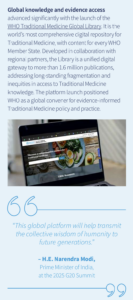 The prominence given to the TMGL at WHA79 and in the 2025 Annual Report reflects the trajectory built over the past few years. The adoption of the WHO Global Strategy on Traditional Medicine 2025–2034 at WHA78 established the policy framework underpinning the platform. Among the Strategy’s four strategic objectives—strengthening evidence, promoting appropriate regulation, supporting integration into health systems, and expanding the cross-cutting value of Traditional Medicine—TMGL emerges as one of the key tools for achieving the first of these: strengthening the global evidence base.
The public launch of the Library in December 2025—during the 2nd WHO Global Summit on Traditional Medicine, in the presence of Dr. Tedros and Indian Prime Minister Narendra Modi—marked a decisive milestone in its international consolidation. On that same occasion, the Delhi Declaration explicitly incorporated a commitment to strengthen the TMGL as a globally governed repository of knowledge, focused on the protection of intellectual property, equitable access to information, and evidence-based policymaking—transforming the platform for technical innovation into a multilateral political commitment.
The series of references to the TMGL throughout WHA79—in the Director-General’s speech, at the GTMC side events, in the Delhi Declaration, and in the 2025 Annual Report—signals that the platform has entered a new phase in its institutional trajectory. At a time when the WHO seeks to consolidate global architecture for Traditional Medicine based on evidence, international cooperation, and regard for cultural diversity, the TMGL establishes itself as a strategic infrastructure to support research, innovation, and public policy formulation. Co-created by BIREME/PAHO in partnership with the GTMC and built through collaboration with networks and institutions around the world, the platform is positioned to play a central role in building more inclusive, resilient, and culturally responsive health systems.
References
OPAS. Asamblea Mundial de la Salud abre con foco en equidad, resiliencia y cooperación mundial en salud; las Américas desempeñan un papel activo. 18 maio 2026. Disponível em: https://www.paho.org/es/noticias/18-5-2026-asamblea-mundial-salud-abre-con-foco-equidad-resiliencia-cooperacion-mundial
Fiocruz. Fiocruz amplia articulação global em saúde durante 79ª Assembleia Mundial da Saúde. Maio 2026. Disponível em: https://fiocruz.br/noticia/2026/05/fiocruz-amplia-articulacao-global-em-saude-durante-79a-assembleia-mundial-da-saude
GTMC/OMS. Advancing universal health coverage through Traditional Medicine: 79th World Health Assembly. Disponível em: https://www.who.int/publications/m/item/advancing-universal-health-coverage-through-traditional-medicine–79th-world-health-assembly–geneva–switzerland–18-23-may-2026
WHO GTMC. Annual Report 2025. Disponível em: https://cdn.who.int/media/docs/default-source/who-global-traditional-medicine-centre/gtmc-annual-report-2025.pdf
OMS. Discurso do Diretor-Geral aos Estados-Membros na 79ª Assembleia Mundial da Saúde, 19 maio 2026. Disponível em: https://www.who.int/news-room/speeches/item/who-director-general-s-address-to-member-states-at-the-79th-world-health-assembly—19-may-2026