Artificial intelligence in BIREME’s products and services
In last month’s article, this column provided an overview of the race toward Artificial Intelligence (AI) through the history of BIREME and its position in the Latin American and Caribbean region. This month, we’re taking a closer look. When we say, “BIREME uses AI,” it’s worth asking: which AI?
“Artificial Intelligence” has become a catch-all term for very different things. In the news, AI is almost always synonymous with ChatGPT and similar tools. But the AI currently used in BIREME’s products belongs to distinct families, each with varying strengths, costs, and limitations. Understanding these differences isn’t just a technical detail: it’s what allows us to choose the right tool for each problem.
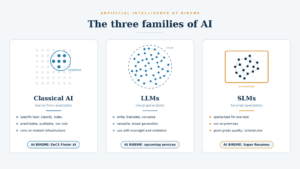
Classic AI: Learning from Examples
The first family is that of traditional machine learning, which some call “classic AI.” It doesn’t converse, write texts, or improvise. It learns from examples and performs a specific task—always the same one.
This is the case with DeCS Finder AI, the service that automatically suggests DeCS descriptors and currently powers automatic indexing on the Virtual Health Library portal. Built on Annif, an open and well-established framework, DeCS Finder AI was trained using thousands of documents already indexed using the LILACS Methodology. When presented with a new document, the tool searches for the most similar indexed documents, analyzes their descriptors, and proposes the most likely ones in Portuguese, Spanish, and English.
There’s no magic involved. It’s based on statistics derived from the accumulated work of decades of human indexers. This is the path the National Library of Medicine took with MEDLINE, from assisted indexing in 2002 to human-curated automation in 2022. Classical AI has virtues that often go unnoticed: it is predictable, auditable, cost-effective to operate, and runs on modest infrastructure. For executing well-defined tasks, it remains unbeatable.
LLMs: Powerful Generalists, with Drawbacks
The second family consists of large language models (LLMs), the AI that has been dominating public debate in recent years. These are models with hundreds of billions of parameters, trained on immense volumes of text, capable of writing, summarizing, translating, and conversing on almost any subject. Here we have OpenAI ChatGPT, Google Gemini, Microsoft Copilot, Anthropic Claude, and others. This generality and versatility of use come at a cost. To function, state-of-the-art LLMs rely on a highly robust computational infrastructure, which is virtually unattainable outside the domains of their own creators. As a result, they entail significant operating costs when used at high volumes.
From the perspective of institutional sovereignty, there are also factors that must be considered and that may vary depending on the type of contract; in most cases, data must be transferred and processed in other countries, raising legal questions when it comes to personal data. There is also a more subtle limitation, which a May 2026 Perspective article in the New England Journal of Medicine summarizes in a single question: Can AI say, “I don’t know”? Few scenarios are more problematic than a confident yet erroneous system, and these models tend to respond with the same degree of certainty whether they know the answer or not. Despite recurring efforts by their creators to mitigate this behavior, it still persists due to the very structural characteristics of this type of AI.
Therefore, using an LLM effectively is less a matter of avoiding the tool and more a matter of designing the environment around it: workflows that expose uncertainty, validation where errors are costly, and epistemic humility treated as a design requirement, not as an optional virtue. It is by this standard that we evaluate LLMs for BIREME’s upcoming services. For indeed, there is no escaping the possibilities opened up by the advent of LLMs, but there is a way to harness all this power rationally and under supervision.
SLMs: Tailor-Made Specialists
In the relentless and fast-paced race of technological evolution, it could be said that the third family presented here is already an old acquaintance of BIREME: small language models (SLMs). These models are similar in nature to LLMs, but with 1 to 8 billion parameters, fine-tuned for a specific task, and capable of running entirely on our infrastructure.
This is the technology behind Super Summaries, which generates hyper-synthetic versions (between 38 and 62 words) of the abstracts of scientific articles available on the VHL Portal: a middle ground between DeCS descriptors and the full abstract. We use an open-source model with three billion parameters, specialized by BIREME’s own AI team and run on premises — i.e., on our own infrastructure.
Does it work? We asked this question as honestly as possible: through a blind evaluation, with 615 pairs of summaries judged by an information specialist, comparing the small, specialized model with a large commercial model. The commercial model won (average score of 9.65 versus 9.13, on a scale of 0 to 10), but by a narrow margin. For the right task, a specialized model with three billion parameters delivers quality comparable to that of a general-purpose model—hundreds of times larger—with functional stability and no recurring costs.
The choice is intelligence
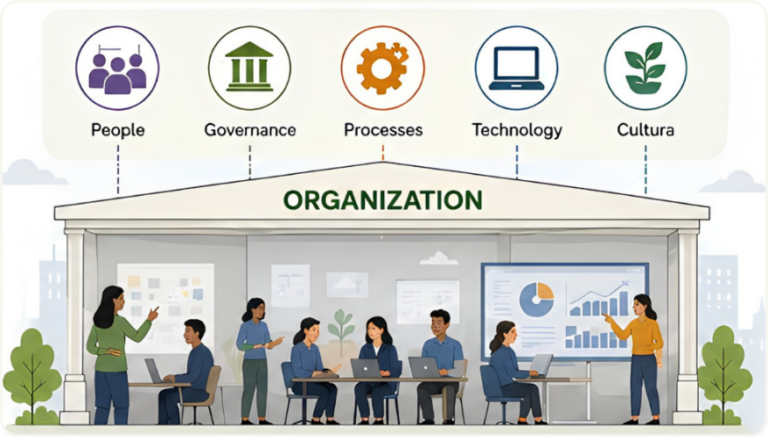
What these three approaches teach us is that the right question today has shifted from “Should we use AI?” to “Which AI solves this problem, at what cost, and with what guarantees?” At BIREME, traditional AI indexes, SLM summarizes, and LLMs are used where their versatility outweighs the trade-offs. Everything created with AI here is transparent and bears the “Created by AI” tag. Choosing the right tool, however, requires more than technical knowledge: it requires an organization capable of learning. Evaluate before adopting, measure before scaling, and abandon what doesn’t work. Understanding the differences between AI families only becomes an advantage where this culture exists.
Artificial Intelligence accelerates. Human Intelligence makes the decisions. That, perhaps, is the difference that matters most.
By Francisco Barbosa Junior, BIREME’s Digital Solutions and Emerging Technologies team.