A view of the race, from here – AI, Information and Health in the Region
April 2025. Kigali, Rwanda. During this mission, Francisco Barbosa Junior, Artificial Intelligence specialist from the Digital Solutions and Emerging Technologies (DEV) team at BIREME/PAHO/WHO, attended the Global AI Summit to present some of the products that BIREME Bulletin readers already know well: DeCS Finder AI and Super Summaries. That week, on the Summit’s main stage, researchers and leading figures in technology discussed Artificial Intelligence (AI). In one of the presentations, a figure raised concern: only 2% of the world’s AI server capacity is installed in Africa. Read the reflection below:
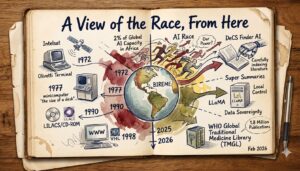
What is the percentage and the capacity of Latin America and the Caribbean (LAC) in supporting AI infrastructure? This is the question that guides this first article on artificial intelligence at BIREME.
Every day it feels as if the whole world has woken up to a new race within the great race for AI. A new model, a new feature, a new AI. A race in search of uses that we aren’t even sure of will actually help us, or if they’ll just consume more and more natural resources. For BIREME, this is just another race. It’s worth pausing for a moment, before talking about the future—or the present—and looking back… not with nostalgia, but through the lens of technology’s chronology.
Let’s go back to 1972, fifty-two years before I walked through that door. BIREME had an Olivetti terminal in São Paulo. A terminal connected via Intelsat satellite to the National Library of Medicine (NLM) in the United States. That was how the world’s biomedical literature reached our region: through a single electronic terminal. In 1977, BIREME received a minicomputer. Note, a mini, not a microcomputer, as many of us know and use. The audacity to demand full access to science, from here, came from a machine the size of a desk.
Fast forward nearly two decades. In 1990, articles were written about what was underway: the CD-ROM revolution for the dissemination of information. BIREME was present and active, through the LILACS/CD-ROM project, distributing LILACS organized on CDS/ISIS, a UNESCO platform that became the standard for libraries in the developing world. We were not at the forefront of manufacturing, but we were at the forefront of use and access. It is a difference worth noting.
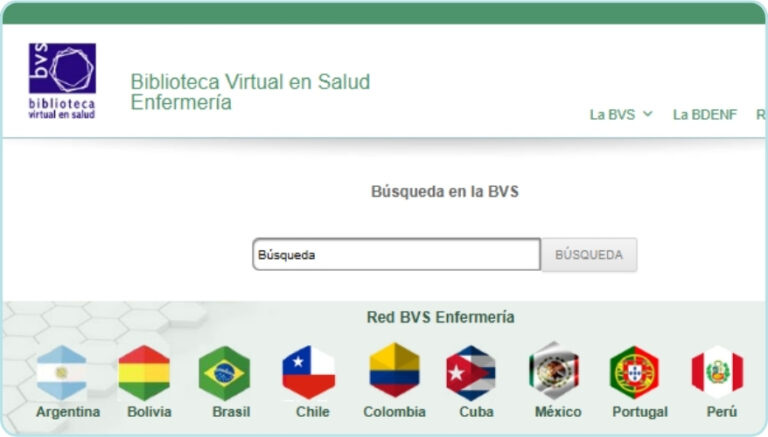
Soon after came the Web, the www. As noted in BIREME Bulletin No. 6, in the special issue marking the Center’s 50th anniversary, “… the use of international standards and free and open-source software came to be regarded as a fundamental guideline for expanding the capabilities for managing, searching, retrieving, and using health information in Latin American and Caribbean countries.” In March 1998, the Virtual Health Library (VHL) was launched, with the mission of using the internet as a platform for the production of and access to knowledge. Each wave brought the same challenge: the technology already existed, but the hard work was bringing it here in a meaningful way: in Portuguese, in Spanish, within our libraries and health decisions. The race changes, but the drive to bring it to Latin America and the Caribbean does not.
And so, we arrived at the present time. What is our potential? What is our capacity? Among them, we have: DeCS Finder AI, which applies Natural Language Processing (NLP) trained by our team to index health literature in our languages, without glitches. Super Summaries, a service that synthesizes scientific evidence in a few lines and run on a scaled-down version of LLaMA on our own servers: local control, data sovereignty, low energy consumption. For us, this isn’t a technical detail: it’s our mission. And the guidelines that govern what goes into production: transparency, security, human oversight. In December 2025, the World Health Organization launched the Traditional Medicine Global Library (TMGL), featuring 1.8 million open-access publications, developed by BIREME and incorporating our AI products.
This column isn’t going to explain AI to you. It’s going to tell you how we’re taking part in this race. From here, with 59 years of experience in information revolutions, and with the stubbornness I inherited back in 1990, knowing that the point was never having a CD-ROM drive before everyone else. It was having something to read on it.
See you next month.
By Francisco Barbosa Junior*
*Francisco Barbosa Junior is a biomedical informatician with a Ph.D. in Public Health. He is a member of BIREME’s Digital Solutions and Emerging Technologies team, where he works on the development of artificial intelligence applications focused on health information and knowledge.