The VHL reaches 28 years
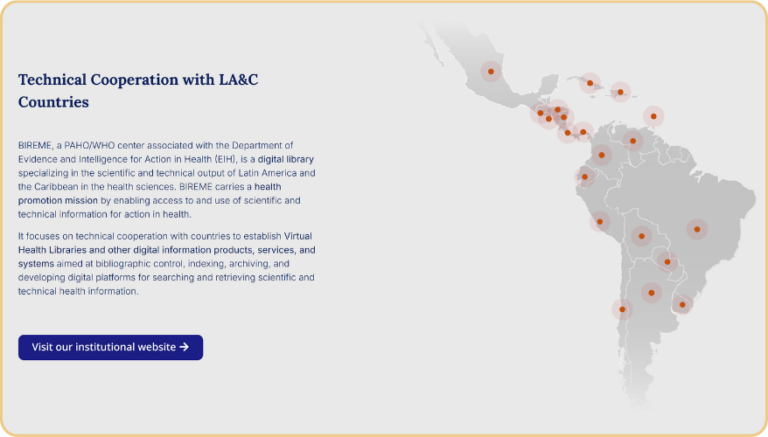
The Virtual Health Library (VHL) is marking 28 years as BIREME’s main technical cooperation strategy for health information management in Latin America and the Caribbean. Launched in March 1998 as a network-based cooperation model, the initiative was driven by the then innovative use of the Internet as a platform for knowledge production and access. Throughout its trajectory, the VHL has consolidated itself as a regional reference for coordinated cooperation among institutions and professionals. Since then, its mission remains strong and up to date: to organize, give visibility to, and expand the use of scientific and technical health information.
Over time, the VHL has evolved in alignment with BIREME itself: from decentralized bibliographic organization to the operation of integrated digital environments, oriented toward open access, strengthening health systems, and evidence-informed decision-making. “The sustainability of the VHL is based on the use of robust and shared methodologies, qualified information sources, and interoperable platforms, forming an articulated system for the production, mediation, and retrieval of scientific and technical knowledge across different national, thematic, and institutional contexts,” notes Verônica Abdala, manager of BIREME’s Information Products and Services (PSI) area.
According to area data, by the end of 2025, the VHL Regional Portal brought together 58 information sources, more than 39 million records, and an annual average of 41 million access sessions, confirming its relevance as one of the main gateways to scientific health knowledge in the Region. The model was also internationally recognized in 2022 as a Good Practice in South-South Cooperation by the United Nations.

During a webinar held in March under the Program “BIREME 2026 – Launches and new developments,” Verônica Abdala highlighted that celebrating the VHL’s 28th anniversary is also about recognizing its importance as a reference in information management and networked work. According to her, the VHL has been consolidated as “a strategy, a policy, and an operational platform” for health information and knowledge management in the Americas, articulating architecture, technologies, sources, and information services to generate knowledge applied to health.
The reflection presented in the webinar also emphasized that the continuity and relevance of the VHL are directly linked to the solidity of its foundations. These include bibliographic control of scientific and technical production, curation of reliable sources, the use of established methodologies such as LILACS and DeCS, and the ability to operate in coordination with national and thematic networks. “These elements sustain the quality, relevance, and timeliness of the information made available to different audiences in the Region,” Verônica emphasized.
In a scenario marked by accelerated transformations in how information is produced, searched, and used, the VHL continues to be called upon to evolve. In recent years, the incorporation of new technologies, including artificial intelligence resources, has expanded possibilities for automation, personalization, and access, while reinforcing the need to preserve principles such as quality, transparency, relevance, and the promotion of equitable access to knowledge. In this context, the VHL continues to play a strategic role as a trusted infrastructure and model for scientific health information in regional cooperation.
As it marks 28 years, the VHL renews its commitment to strengthening health information and knowledge management in Latin America and the Caribbean. Its trajectory reflects the strength of collective work built through networks, grounded in technical cooperation, continuous innovation, and the democratization of access to scientific and technical information.