Key Results in the Last Semester at BIREME
BIREME/PAHO/WHO registered significant progress in fulfilling its mission to support countries in the Latin American and Caribbean Region with scientific and technical health information through its products and services. The BIREME Bulletin compiles 15 highlights from the past semester, as follows:
Management and Operation

- Implementation of BIREME Strategy 2023-2025 for the digital transformation of the Center, using artificial intelligence (AI) and Large Language Models (LLM) to foster innovation and the implementation of Agile Culture;
- Effective development of technical cooperation projects with the strengthening of the Project Management Office (PMO) using agile methodologies recognized as good practice in the Pan American Health Organization (PAHO), in the PAHO Forward 2.0 initiative;
- Follow-up actions to formalize the Headquarters Agreement in Brazil and, in parallel, the formalization of TA5/TC93 for the improvement of BIREME;
- Holding of the XIV Advisory Committee (AC) and XI Scientific Committee (SC) sessions;
- Effective management of BIREME’s operations, including internal and external communication actions, operation of services, servers and information and communication technology (ICT) platforms, and maintenance of regular actions for the development of skills and strengthening of the organizational climate. In addition, initiatives to strengthen skills in project management and product development were implemented.
Implementation of its technical cooperation program

- The regional portal of the Virtual Health Library (VHL) continued to operate regularly, offering access to a broad collection of more than 50 information sources and approximately 40.5 million scientific and technical documents. In the second half of 2025, 13.2 million access sessions in the Regional VHL were recorded, originating from 9.7 million users, generating 106.2 million events – 27.4 million page views, 12 million search result views and 246,000 full-text downloads.
- The Literature in Health Sciences of Latin America and the Caribbean (LILACS) completes 40 years, with a collection of over 1.13 million documentary records from 30 Latin American and Caribbean countries, 63% of which have links to the full text. The LILACS database was updated with over 13,000 new records in the second half of the year, with contributions from 200 cooperating centers in 18 countries. The evaluation and selection process for LILACS Brazil 2025 journals began with 28 journals, of which five reached the final evaluation phase.
 The LILACS Plus collection, which includes content from LILACS and national and thematic databases of the region, as well as publications from Latin American and Caribbean countries and authors indexed in MEDLINE, is available on the VHL Regional Portal and brings together over 2.8 million documents, improving the visibility of the region’s scientific production. The study “Profile of Journals Indexed in LILACS” 2025 was updated and published on the LILACS Portal with data from 934 journals from 19 countries. This initiative supports strategic actions for editor training, updating indexing criteria, promoting good editorial practices, and technical and operational improvements in LILACS. 10 meetings were held with an average of 145 connections from 36 countries on the themes of access and use of information, indexing of documents according to the LILACS methodology, good practices in the editorial processes of LILACS scientific journals, and innovation in VHL products and services.
- The 2026 edition of the Health Sciences Descriptors (DeCS) has 160 new descriptors from the annual update of “Medical Subject Headings” (MeSH) and 37 that were incorporated into exclusive categories, totaling an increase of 197 new records. The DeCS portal and the DeCS Finder AI service recorded approximately 1.7 million access sessions by 900,000 users, generating more than 27.6 million events (page views, search result views, and others). The model used in the DeCS Finder AI service was updated, with an expanded knowledge base for training, and a descriptor suggestion service for AI-assisted indexing was made available in FI-Admin, the VHL Information Sources Administration system.
- Technical cooperation at the global level in coordination with the World Health Organization (WHO):
(i) maintenance and operation of the Global Index Medicus (GIM), an informational product that integrates scientific production at the regional level from all WHO regions (WHO Regional Offices operate the GIM, which has a database with more than 2 million records);
(ii) operation of the Index Medicus AFRO/WHO on the VHL technology platform;
(iii) launch, in December 2025, of the Global Library of Traditional Medicine (version 1.0), in cooperation with itsGlobal Centre for Traditional Medicine, at the second WHO Global Summit on Traditional Medicine. The portal includes six regional portals, 194 country pages, and two thematic pages: Ayurveda and Traditional Birth Attendance. The library collection brings together collections of scientific and technical documents (more than 1.7 million), multimedia, periodicals, evidence maps, repositories and databases of bibliographic data, policy and regulatory data, in addition to the collection from the first session of the WHO Global Summit on Traditional Medicine. Innovations based on artificial intelligence, such as a specific thematic GPT model, are also being implemented.. - Regular operation of the GRADE Guidelines and Recommendations portal in the VHL, in collaboration with PAHO, through its Science and Knowledge for Impact Unit. The portal includes BIGG (International GRADE Guidelines Database), BIGG-REC (GRADE Recommendations for SDG-3) and BIGG-Map (Evidence Maps based on GRADE recommendations), as well as the PIE (Evidence-Informed Policies) database and the Evid@Easy tool (guided evidence search). These products facilitate access to resources that support clinical and public health decision-making, produced by WHO, PAHO and other national and international institutions that follow the GRADE approach.
- Application of the Evidence Map methodology offered by BIREME with the publication of 22 new Evidence Maps, 11 of which were created in the second semester. The following maps were also
 updated and made available in the TMGL collection, in English: Yoga, Meditation, Reflexology, Acupuncture, Cupping Therapy, and Shantala. Currently, the VHL Evidence Maps Portal (https://bvsalud.org/mapa-de-evidencias/) has 89 registered maps. The Windows of Knowledge portal (https://bvsalud.org/vitrinas/) is available with 63 active windows. During this period, 15 windows related to health commemorative dates were updated, and five new windows were created: World Health Day 2025, Zoonosis Surveillance, Primary Care, Food, Nutrition and Physical Activity, and Los Diálogos de Saberes de la OPS.
- In collaboration with the Secretariat of Information and Digital Health of the Ministry of Health of Brazil (SEIDIGI/MS) and PAHO Brazil, BIREME is developing four products in the context of TC157, dedicated to Digital Health:
(i) New program for the Second Formative Opinion (SOF). 506 analyses of published SOFs, 449 updates, 31 revisions of unpublished SOFs, and 16 conversions of recommendations into SOFs were carried out. 70 new SOFs on Evidence-Informed Policies (SOF-PIE) were also incorporated, and the identification, tagging, and processing of existing SOFs according to the six medical specialties of the Now There Are Specialists Program (Cardiology, Oncology, Orthopedics, Ophthalmology, Otorhinolaryngology, and Gynecology) were carried out;
(ii) Version 1.0 of the new online management system of the SOF Network – SOFNet (sofnet.teste.susdigital.org.br) and the new SOF portal (sof.teste.susdigital.org.br) are available in a test environment;
(ii) Decision Aids (DA). Three DAs are under development: Contraceptive methods, Contraceptive methods for adolescents, and Hormone therapy for menopause. The DA portal is available in a production environment (ajudasdecisionais.susdigital.org.br);
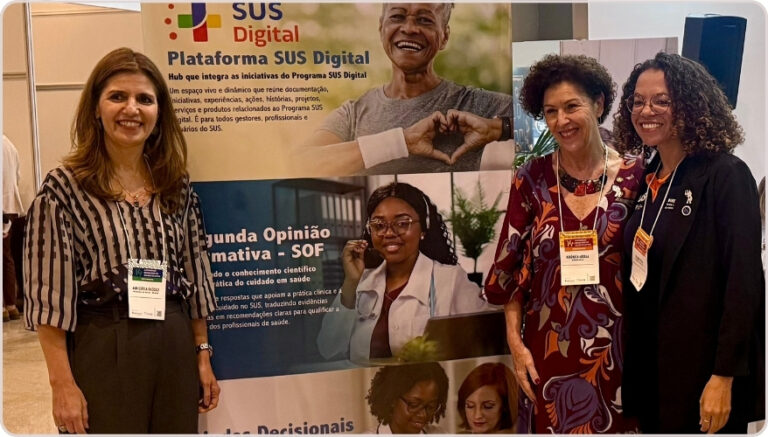
(iii) SUS Digital Platform. Development of the alpha version of an interactive and integrative portal (hub) for information, documents, tools, services, projects, and products related to the SUS Digital Program (available at http://susdigital.org.br); and
(iv) RIPSA Portal – Interagency Health Information Network. RIPSA held its 32nd OTI and made progress in updating the portal, with layout improvements and content revision. The new Indicator Qualification Sheets portal (IDB Sheets Portal) was made available, the API for reading the sheets in MGDI was improved, and support was provided to the RIPSA team for continuous updating of the portal and for generating DOIs for the sheets. The initiative was also presented at the roundtable and at the PAHO and Ministry of Health booth during the 14th Brazilian Congress of Collective Health – Abrascão, expanding its dissemination to the public health community.
- Development of the Portal of the Covid-19 Pandemic Digital Memorial in the context of TA13/TC95 with CGDI/SAA/SE/MS with the objective of preserving digital records and guaranteeing access to the experiences lived by the Brazilian population during the pandemic. Its development has been periodically monitored by professionals from the Cultural Center of the Ministry of Health and by specialized researchers. The launch of this Portal is scheduled for April/26.
- Consolidation of the Indigenous Peoples Virtual Health Library in conjunction with BIREME and the Special Secretariat for Indigenous Health (SESAI/MS), including the integration of more than 770 qualified contents (internet resources, multimedia, events, legislation, and 535 bibliographic records), the completion of the Indigenous Health Timeline – which will also be included in the SESAI’s 15th-anniversary book – and the conclusion, review, and validation, with the CGCOIM, of the Knowledge Showcases “Indigenous Medicines” and “Emergency in the Yanomami Indigenous Land,” structured to support the management, care, and tackling of current challenges in Indigenous Health. The official launch is scheduled for the first quarter of 2026.

- Development of artificial intelligence initiatives:
(i) implementation of the Super Summaries service in the Mosaico database (integrative health);
(ii) coverage of approximately 60% of the LILACS database with Super Summaries generated from a specialized language model;
(iii) development of automated processing for the inclusion of Super Summaries in new database records;
(iv) in the context of automatic indexing, availability of descriptor suggestions in FI-Admin (information source management system) and initiation of the first phase of implementation of automatic indexing in the integrated search service (iAHx); (v) planning and technical-methodological analysis to generate abstracts from full texts aiming to improve the iAHx metadata; and
(vi) beginning of the analysis and design of the natural language search solution with definition of the vector generation model for proof of concept.
The results achieved in 2025 demonstrate the commitment of the BIREME technical and administrative teams, under the leadership of its Director, João Paulo Souza, as well as the cooperation with the actors of the VHL Network and associated institutions, who work in an integrated manner in the development and updating of information products.
As a specialized center of PAHO/WHO and part of the Department of Evidence and Intelligence for Action in Health (EIH), BIREME has the strategic support and recognition of the Government of Brazil, through the Ministry of Health, in addition to the continuous support of the countries of the Region, to continue efforts to democratize access to scientific and technical health information.